15 January 2026, 19:10
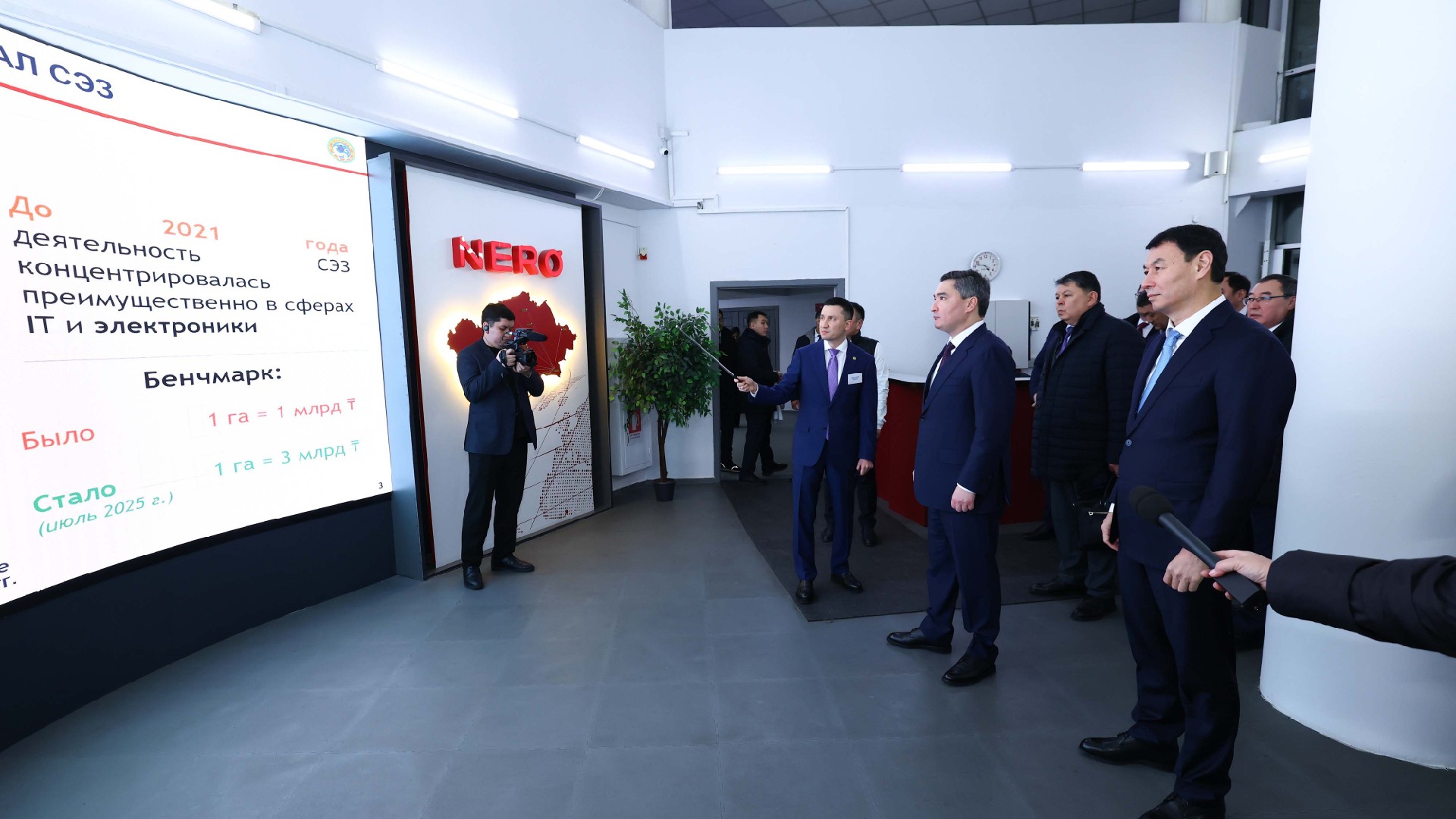
Prime Minister Olzhas Bektenov inspected the implementation of the Head of State’s instructions to strengthen the industrial potential of the regions through the development of special economic zones and industrial zones and by improving the efficiency of their operations, as set out in the Address “Kazakhstan in the Era of Artificial Intelligence: Current Challenges and Their Solutions through Digital Transformation.”
During a visit to the Alatau Innovation Technology Park special economic zone (SEZ) in Almaty, the Prime Minister reviewed the development of infrastructure aimed at advancing high-tech manufacturing, deepening localization, and expanding the SEZ’s infrastructure.
Deputy Akim of Almaty Olzhas Smagulov reported on plans for infrastructure provision for the SEZ. The Alatau Innovation Technology Park SEZ is being developed as a platform for high-tech manufacturing and R&D. It currently has 203 resident companies. Over the entire period of operation, residents have invested approximately 399 billion tenge, created 7.2 thousand permanent jobs, and produced goods and provided services totaling 1 trillion tenge. At present, 24 projects worth 265 billion tenge are being implemented within the SEZ, creating around 1,000 jobs. In 2025, six projects were launched with investments of 19 billion tenge, resulting in the creation of 355 jobs.
According to the Almaty city akimat, the SEZ is effectively 94% occupied, with available land plots totaling 7.7 hectares. At the same time, the operational period of the SEZ is limited to the end of 2027, which complicates the launch of capital-intensive and long-term projects and reduces its attractiveness to investors. In this regard, to maintain growth momentum and implement planned initiatives, the Prime Minister instructed to extend the SEZ’s operating period, expand its territory, and supplement the list of permitted activities, taking into account the objectives of diversification and the launch of new high-tech manufacturing.
Prime Minister Olzhas Bektenov emphasized the importance of further developing SEZs and ensuring infrastructure readiness as a key factor of investment attractiveness. This work should be pursued across all regions of the country. To this end, the Government is taking measures to significantly improve infrastructure quality for future investment projects. Akimats were instructed to intensify efforts to attract private investment in this area.
“In the Year of Digitalization and Artificial Intelligence declared by the President, conditions must be created for launching ultra-high-tech projects. This includes the development of additional infrastructure, including substations and transport networks.
The Alatau Innovation Technology Park SEZ, as a technological platform, is already heavily utilized. However, given the high investment demand, the zone must be further developed. To reduce dependence on the republican budget, the akimat, together with the SEZ administration, should actively attract extra-budgetary funds and cooperate with international financial organizations,” the Prime Minister noted.
At the production site of NERO Group, located within the Alatau Innovation Technology Park SEZ, the Prime Minister was briefed on the development of domestic manufacturing of metering devices.
 At present, the company’s production line includes systems and meters for heat, water, electricity, and gas. The project cost amounts to 1.5 billion tenge, with a production capacity of over 10 thousand units per year. 65 jobs have been created, with total staff numbering 150 people. The company combines manufacturing and engineering competencies, including the development of software for metering and monitoring systems.
Founder of NERO Group Yerlan Nabiyev presented a comprehensive project for the localization of high-tech manufacturing for 2025–2027 with a total value of approximately 44.8 billion tenge. The initiative предусматривает the creation of more than 650 jobs, expansion of production facilities to 21,068 square meters, and the launch of new areas, including the production of cable products and components, expansion of gas meter manufacturing, as well as the production of unmanned systems and robotics. The project also includes the training of engineering personnel: 60 people per year through bachelor’s degree programs and up to 200 people through advanced training programs.
A project for the Smart Energy scientific and educational cluster was also presented, with the participation of AUES and the Kazakh Center for Housing and Utilities, providing for the integration of education, science, and production, the introduction of dual education, and the training of engineering personnel.
 In addition, a project was presented to localize the production of AI-based educational and service robots in cooperation with UBTECH Robotics (China). Demand for this area has already been formed, and offtake contracts have been concluded for the deployment of AI laboratories. Planned capacity is approximately 25 thousand sets per year. The project envisages the creation of 80 jobs, with further expansion.
Furthermore, the Prime Minister was presented with a digital solution developed by the company for monitoring heat supply. The system automatically collects readings from building-level metering units and displays them on a web map with “traffic-light” analytics, indicating areas of underheating or overheating, deviations in heat consumption, and hot water usage. This allows dispatch services and natural monopoly entities to identify problematic addresses more quickly and respond promptly. The solution has already been implemented in Karaganda, Satpayev, and Zhezkazgan. Yerlan Nabiyev emphasized the importance of scaling the initiative and formalizing it as a mandatory digital quality-control framework for heat supply for natural monopoly entities.



Stay updated about the events of the Prime minister and the Government of Kazakhstan - subscribe to the official Telegram channel
Subscribe