05 February 2019, 11:04
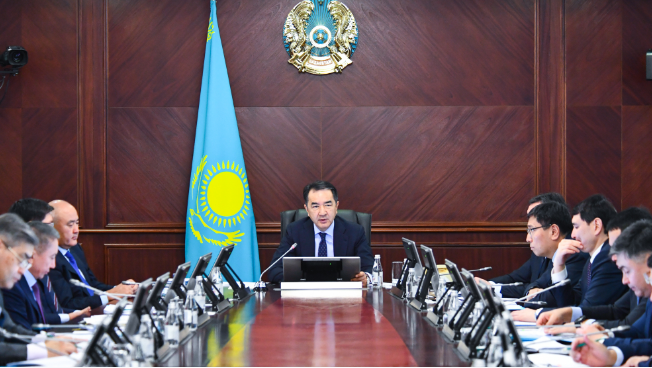
Feb. 5 at the meeting of the Government, the responsible state bodies were heard on the proposed measures for the execution of President Nursultan Nazarbayev’s instructions set at an extended Government meeting Jan. 30, 2019.
In general, the Government’s work is recognized as satisfactory. At the same time, the Prime Minister Bakytzhan Sagintayev noted that the high assessment of Elbasy indicates that it will take more efforts to solve the tasks set for the current year and the implementation of these instructions.
The Government is tasked to be ready for different scenarios of economic development, to ensure sustainable economic growth and to pay special attention to two indicators — incomes of the population and quality of life. The Head of State also noted such indicators as increasing the share of small and medium-sized businesses, ensuring the growth of non-commodity goods and services, and increasing labor productivity. The work of each minister and akim will be evaluated in all these parameters.
Deputy Prime Minister – Minister of Agriculture Umirzak Shukeyev, Chairman of the National Bank Daniyar Akishev, ministers of foreign affairs Beibut Atamkulov, national economy Timur Suleimenov, finance Alikhan Smailov, industry and infrastructure development Zhenis Kassymbek, education and science Yerlan Sagadiyev, as well as vice ministers of labor and social protection of the population Svetlana Zhakupova and healthcare Alexey Tsoy reported on the approaches to ensure the implementation of the tasks.
Minister of National Economy Timur Suleimenov said that, in fulfillment of the tasks of the President, systematic work will be continued to increase the share of SMEs in the economy, measures will be taken to privatize and de-nationalize the economy further, combat shadow turnover, adjust the Territorial Development Programs. In addition, the work on the formation of an effective state policy to attract investment will be organized under the ministry’s authority.
Systematic work to increase the share of SMEs in the economy:
1) reduction of barriers to business through the implementation at the local level of reforms adopted in 2018 at the legislative level;
2) on allocated 600 billion tenge (at least 100 billion tenge will be directed to SME projects) — practical work on crediting priority projects of private entrepreneurship in the manufacturing industry, processing and production in the agro-industrial complex, and also in the service sector; control over the intended use of funds. In order to reduce the cost of loans issued from these funds within the framework of the Business Road Map-2020, a 3-year budget provides for subsidizing part of the interest rate.
3) in the framework of the extension of the Business Road Map-2020 until 2025, work will be carried out to improve the tools of financial support. The selection criteria will be focused on the productivity and competitiveness of projects with the refusal to support low-performing enterprises, which will achieve maximum economic efficiency of allocated funds from the budget;
4) along with this, non-financial support measures will be improved. In particular, the training programs will provide specialized courses on the application of IT services and new digital solutions for business.
In terms of further privatization and privatization of the economy, the ministry plans to sell 139 objects in 2019. In addition, for 2019, the privatization program included an additional 48 objects. The reform of the structure of state property will be considered through a clear legislative division into commercial and non-commercial ones in accordance with the standards of OECD countries. Along with this, work will continue to bring anti-monopoly regulation in line with the standards of OECD countries, as well as adhering to the accepted principles of the Yellow Pages.
In the area of investment in the framework of the authority transferred to the ministry, work will be directed towards the formation of an effective state policy on attracting investments. A permanent Investment Headquarters has been created under the Ministry, the tasks of which will be the development of practical proposals for improving investment legislation, the institutional environment and the climate as a whole.
In order to work out specific measures aimed at increasing the potential for the development of regions and incomes of the population, it is planned to change the format of the Territory Development Program to synchronize it with the Strategic Plan-2025 until July 1, 2019. By the end of 2019 the akims, together with the Atameken National Chamber of Entrepreneurs, will analyze and screen the regions. In 2020, taking into account the new format and analysis, all regions will adjust their Territory Development Programs, where they will more clearly sign out plans and measures for the development of promising industries, attracting investment and creating new jobs.
“The results of the analysis will be synchronized with the country’s Forecast Scheme of the Territorial and Spatial Development until 2030 and the new State Program for the Development of Regions until 2025. On the basis of the map of problematic issues of the regions, work will be carried out to address systemic infrastructure issues (the state of roads, hospitals, schools, rural water supply, housing and public utilities and other socially significant issues). The ministry plans to resolve these issues, both when refining for 2019 and when forming the budget for 2020,” Suleimenov reported.
To reduce the level of non-observed (shadow) economy, the Ministry of National Economy together with the Ministry of Finance will work out a question on measures of tax, trade policy, industry regulation, aimed at increasing non-cash money circulation in the economy. Issues of setting a limit on cash payments for the purchase of goods, works and services, and the mandatory cashless sale of real estate and transport will be considered.
In turn, the Chairman of the National Bank of Kazakhstan Daniyar Akishev said that as part of the execution of the instructions of the Head of State, the policy of improving the financial sector and introducing best international supervision practices, including on a risk-oriented basis, will be continued. One of the important steps in this direction are legislative amendments on the absolute priority of secured creditors, which will increase the interest of creditors in the bankruptcy of enterprises, improve the real sector, and involve collateral in economic circulation.
In 2019, the National Bank will begin preparatory work to conduct a comprehensive assessment of the quality of banking assets, the financial regulator has already started discussing these issues with banks. Following the example of the 7-20-25 Program, the bank is ready to work out in detail the loan program for citizens of Kazakhstan to purchase domestically produced cars with interested government agencies and banks in the first half of 2019 and launch the program in the second half of the year.
Deputy Prime Minister – Minister of Agriculture Umirzak Shukeyev reported on the planned measures for the execution of the instructions of the Head of State for the development of the agro-industrial complex. In particular, plans to increase the export of meat, to ensure the import substitution of agricultural products, the development of poultry farming and dairy production, as well as the diversification of acreage.
To increase the export of cattle meat, the implementation of the branch program for the development of meat cattle breeding will be continued, in which funding has been laid down and specific indicatives have been identified: 1.2 million head of cattle for breeding; for the supply of gobies to feedlots — 353.6 thousand heads; for the purchase of breeding stock of cattle — 100 thousand heads for the purchase of breeding cattle — 415.75 thousand heads. In 2019, it is planned to export 30 thousand tons of beef.
In order to develop transhumance, 1,873 wells were built in 2018 (259% of the plan), of which 6,082 million tenge of subsidies were issued for 1,369. As a result, 2,244.4 thousand hectares of pasture lands were provided with water sources for 186.5 thousand heads of cattle, 531.6 thousand heads of small cattle, 57.4 thousand heads of horses, 34.3 thousand heads of camels.
The dairy program provides for an increase in milk production over 10 years by 1 million tons. Indicators of achieving the goal have been defined. By 2027, it is planned to open 527 new family dairy farms with a capacity of up to 400 heads, 139 industrial dairy farms with a capacity of 400 or less. As part of the sectoral program for the development of the poultry industry, it is planned to increase the level of poultry meat production by 3 times over the next 10 years (from 200 thousand tons to 700 thousand tons) and thereby ensure import substitution. Within the framework of the Agrarian and Industrial Complex State Program, it is planned to involve 610 thousand ha of irrigated land until 2021: 65 thousand ha were introducedin 2018, this year it is planned to involve 124 thousand ha.
In order to curb prices for socially important food products, it is planned to create wholesale distribution centers. Already in 2019, the first center in Karaganda is being commissioned. As part of the program of digitization of the agro-industrial complex, in the first quarter of the year, full automation will be implemented in 15 areas of subsidies, 80% of the 106 public services will be automated. Currently, 500 households are being selected, in all regions, which will begin system implementations from 2019.
Finance Minister Alikhan Smailov reported that in order to reduce the state’s share in the economy this year, according to the Comprehensive Privatization Plan, 123 objects of republican, municipal property and a quasi-public sector are to be implemented. As part of the execution of the President’s order on tax amnesty for individuals, a Roadmap has been developed. The planned date for amending the Parliament is March 2019, the adoption of the law in June, and the end of the amnesty by the end of the year.
As of Feb. 1, 2019, 27,868 taxpayers, or 30% of those falling under the tax amnesty, repaid the amount of arrears, which they listed as of Oct. 1, 2018, for 5.9 billion tenge. They will be charged penalties totaling 1.1 billion tenge and fines totaling 0.1 billion tenge.
As part of the execution of orders for a radical improvement in customs administration and in order to reduce discrepancies in customs statistics between the Republic of Kazakhstan and the People's Republic of China, changes will be made to expand the number of exchanged information.
It is planned to integrate the Astana-1 information system with the information system of the Main Customs Administration. This, according to the Minister of Finance, will ensure the accuracy of the declaration of goods by importers. And, most importantly, significantly reduce corruption at the customs border.
To counteract the shadow economy, it is planned to implement the Action Plan for 2019-2021. The measures are aimed at improving customs administration, as well as at stimulating business and strengthening work to bring small and medium-sized businesses out of the “shadow” and increase the share of non-cash turnover.
Regarding the execution of the instructions of the Head of State to revise the current legislation in the field of bankruptcy and rehabilitation, then, according to Smailov, the relevant bill is currently being considered in Parliament. The draft law will be finalized as soon as possible. It is planned that the amendments will be earned from the beginning of the second half of the year, as a result of which the second-tier banks will be able to begin the procedures of cleaning the loan portfolio.
The Minister of Industry and Infrastructure Development Zhenis Kassymbek said that as part of the revitalization of bringing the local road network in good condition to the level of 90%, the Ministry is moving from the current year from expensive capital projects mainly to an economical average cold recycling method. For 2019, on a parity basis, the allocation of funds from the republican and local budgets for 150 billion tenge is provided. Thus, by 2025, the state of the local network will be improved to 90%. Also this year, measures will be taken to open direct flights to the United States, Japan, Shanghai and other major cities in the world.
To ensure the availability of the program for employees of budgetary organizations, work is underway to amend housing legislation on the issue of housing certificates. The program 7-20-25 was amended to the Nurly Zher program, the size of the down payment was reduced from 30% to 20% on loans to the Housing Construction Savings Bank. The Nurly Zher provides for the construction of residential buildings with accommodation on the first floors of social facilities. The construction of at least 1 thousand rental apartments for working youth in the cities of Astana, Almaty and Shymkent will begin.
At the end of 2018, the share of Kazakhstani content in housing construction projects was 86%. Within three years, the level of local content in housing will be increased to 90%.
In turn, Foreign Minister Beibut Atamkulov said that the department had begun work on improving the investment climate in the country and developing new measures to promote Kazakhstan’s exports.
“Without reducing the importance of the political tasks of the state on the external contour, the Foreign Ministry has been reconfigured to ensure the national interests of Kazakhstan in the international economic plane. Following the results of the expanded Government meeting, the Foreign Ministry began work on the implementation of the Head of State’s order to create a complex ecosystem for attracting investments: 40 priority investor countries were identified, performance indicators were developed,” said Atamkulov.
Each embassy was assigned specific tasks, responsible persons were appointed, and new approaches to work were developed.
Atamkulov also reported on strategic issues for changing the investment climate, measures being taken to develop exports and create a new model of export promotion.
The Minister of Education and Science Yerlan Sagadiyev in his report noted that the program Zhas Maman, which will become part of the national project “Zhastar — El Tіregі” will be implemented according to the principle “100/200”: 200 schools will be provided with new equipment, 20 universities and 180 colleges over 3 years in 100 of the most sought-after specialties. Thus, over 210 thousand qualified personnel will be trained. These educational institutions, along with the provision of education, will become centers of competence for other educational institutions. This provides for new equipment in 1-2 specialties, cooperation with foreign partners, new training programs.
Meanwhile, the Ministry of Labor and Social Protection of the Population in cooperation with Atameken will determine the 100 most popular professions in the market, which will become the basis for choosing equipment purchased for educational organizations.
Vice Minister of Labor and Social Protection of the Population Svetlana Zhakupova reported that, pursuant to the instructions of the Head of State to increase the size of social benefits from the State Social Insurance Fund, work is underway to revise the parameters of social benefits. Currently, the social insurance system proposes to revise the parameters for the three types of social risks: these are social payments for cases of disability, loss of the breadwinner and loss of work. The size of social benefits will be set depending on the length of time of participation in the system of compulsory social insurance.
“This will increase the level of social protection of citizens in case of social risks, as well as provide incentives for citizens to participate in the compulsory social insurance system, respectively, to formalize labor relations. The relevant amendments will be made to the legislation on social insurance,” said Zhakupova.
At the same time, work is underway to revise the parameters for the development of a National Plan to ensure the rights and improve the quality of life of persons with disabilities in the Republic of Kazakhstan until 2025. The national plan should provide an integrated and interdepartmental approach to creating conditions for the full integration of persons with disabilities into society. Also, on the special control of the Ministry there are issues of observance of labor rights of workers, repayment of wage arrears. In the regions, there are special headquarters, with the participation of the prosecution authorities, state revenues and justice.
At present, the Ministry of Labor and Social Protection has started the development of an Integrated Roadmap for reducing injuries and jobs with hazardous working conditions for 2019-2021. Systemic measures will be implemented, including the introduction of a national labor protection system based on occupational risk management; improving the mechanisms of state, internal and public control over compliance with labor protection requirements.
Vice Minister of Healthcare Alexey Tsoy informed that the Head of State at the enlarged meeting of the Government was instructed to continue work on improving the quality and accessibility of medical care, especially in the regions.
So, it is planned to purchase 800 ambulance cars and reanimation mobiles. To equip the regions with mobile medical complexes for conducting medical examinations in the villages, the acquisition of 18 mobile medical complexes is planned.
At the same time, within the framework of increasing the availability of medicines, drug provision was centralized, the procurement system through e-procurement was transparent, and electronic accounting for the issuance of free medicines was also established. Along with this, the process of notification of the receipt of medicines by citizens via SMS has been launched.
In addition, in April 2019, limit prices for medicines will be approved.



Stay updated about the events of the Prime minister and the Government of Kazakhstan - subscribe to the official Telegram channel
Subscribe