13 November 2018, 06:15
November 13 at the Government meeting chaired by the Prime Minister Bakytzhan Sagintayev, ministers for Investments and Development Zhenis Kassymbek and Energy Kanat Bozumbayev reported on the current situation and prospects for the development of geological exploration.
Thanks to the wealth of the subsoil resources, Kazakhstan is at the forefront of mineral reserves. According to the Minister for Investments and Development Zhenis Kassymbek, this is why, despite the growth of the manufacturing sector, the geology and subsoil use industry makes a significant contribution to the country's economy and provides a significant inflow of investments. Today it is about 50% of all investments in the country.
The analysis of the situation in the industry, conducted by the OECD, revealed the most acute areas in geology and subsoil use, which are being used for systematic work. Over the past two years, the main indicators hindering the development of this sphere have been changed in a progressive direction. According to the Ministry for Investments and Development, over the past three years a lot of work has been done to change the regulatory legal framework. Pursuant to the instructions of the Head of State, voiced in 74th and 75th steps of the Nation’s Plan, the Code “On Subsoil and Subsoil Use” was adopted and entered into force, which corresponds to international approaches to the regulation of geology and subsoil use
“Within the framework of the Code, the principle ‘First come — first receive’ was introduced, the terms for granting the subsoil use right were reduced, the State Subsurface Resources Management Program was adopted, free access to geological information was provided, many administrative barriers were excluded,” Kassymbek reported.
The KAZRC Public Resource Reporting Code has also been adopted, corresponding to the internationally recognized CRIRSCO system. In the field of geology and subsoil use, the main world rating, which evaluates investment attractiveness, is formed by the Fraser Institute. Previously, Kazakhstan occupied 73rd place in it. After the reforms, we have risen 49 positions and are 24th of 104 countries.
Kassymbek noted that the next step in the reform should be the adoption of world practice in imposing royalties on the sale of raw materials instead of the existing mineral extraction tax. According to him, except for Kazakhstan and Russia, countries that have achieved success in the mining industry use this mechanism.
To improve the quality of the geological database and infrastructure under the Digital Kazakhstan program, a National Bank of Mineral Resources is being created. According to the minister, such bases exist in all the leading countries of the mining and metallurgical complex. This is a system that combines all historical geological data and provides them in the current format.
"The National Databank of Mineral Resources will ensure the transparency of the activities of state bodies and subsoil users, the accuracy of the information provided. It will simplify investors' access to subsoil use, which will increase the inflow of investments. This project will be put into effect by the end of 2019,” noted Kassymbek.
In order to develop human resources, more than 1,600 students are trained annually in the universities of the country. According to the Bolashak program 41 specialists were trained. At the same time, there is a gap in continuity. The average age of an experienced geologist is close to retirement, while young professionals have only recently completed training. In this regard, the ministry proposes to increase the allocation of grants for training and retraining in geological specialties and to update training programs in conjunction with the Ministry of Education and Science.
It should be noted that today Kazakhstan continues to work on traditional types of raw materials, using established practices and techniques, whereas modern trends and new technologies dictate new tasks. For example, electric vehicle engines and smartphone fillings have sharply increased the demand for rare earth metals. Commodity price conditions have changed. Cobalt, lithium, palladium doubled in price. Experts predict a significant increase in gallium, scandium, indium and other rare metals.
To increase the competitiveness of Kazakhstan in this direction, the Ministry for Investments and Development proposes to allocate additional funding for geological exploration, as well as create incentives to attract investment in the search for rare-earth elements. Kazakhstan is interested in attracting investment in exploration through junior companies. To this end, Sep. 15, according to the principle “First come — first receive,” applications for obtaining a license for exploration of more than 85,000 blocks, which is more than 197,000 km², have been started. The term of obtaining a license is only 10 days. In 2019, additional blocking is planned according to this principle.
Investors are interested in pre-studied objects. To do this, it is necessary to carry out work in the early stages. Currently, 1.2 million km² are available for geological study in Kazakhstan. Sonly 21% have been studied at the required level.
“The increase in state financing of the early stages of exploration to 15-20 billion tenge annually will increase the investment potential of the exposed sites and their cost,” said Kassymbek.
According to the Ministry for Investments and Development, investments in geological exploration are also attracted in the framework of public-private partnership projects through the national company Kazgeology JSC. This allowed to attract in the exploration of Kazakhstan such world leaders as Rio Tinto, Illuka, Ildirim, Ulmus, etc. These companies not only conduct research on the territory of the country, but also provide technology transfer.
To solve the problems that have been voiced, the Ministry for Investments and Development is preparing proposals for the development of a comprehensive program of the state geological study of the subsoil for the medium term.
Minister of Energy Kanat Bozumbayev reported on the development of geological exploration in the oil and gas sector. According to the Ministry of Energy, the state balance of oil takes into account recoverable reserves of 277 fields in Kazakhstan. In general, the republic’s recoverable oil reserves as of Jan. 1, 2018, amount to 4.6 billion tons. Most of the reserves are in Kashagan, Karachaganak and Tengiz (about 75%). The total number of subsurface use contracts for hydrocarbons is 217, of which 59 are contracts at the exploration stage. In 2017, the total investment in exploration amounted to 137 billion tenge. For 2017–2018 the Ministry of Energy has concluded 13 subsoil use contracts.
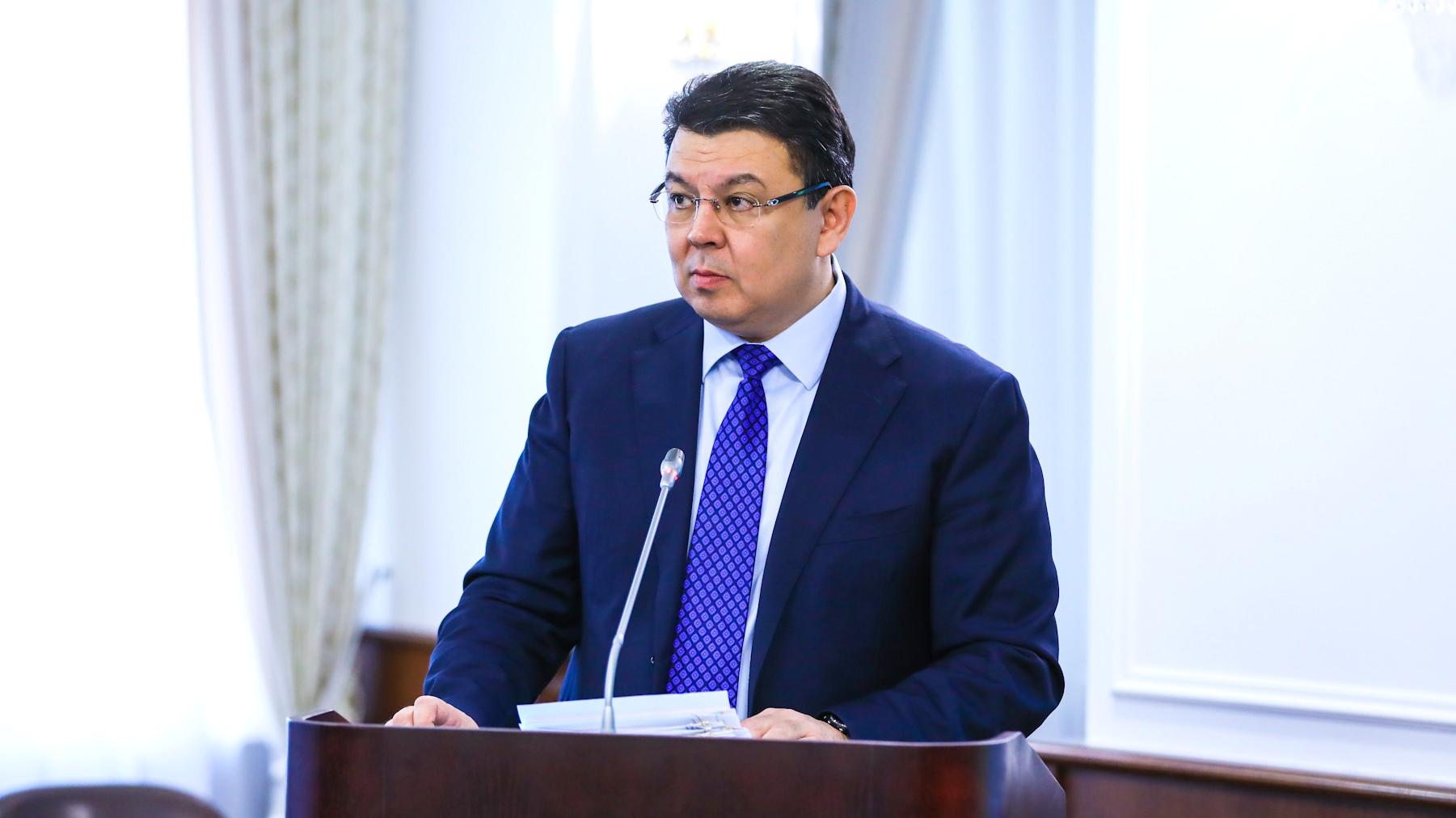
Bozumbayev paid attention to the fact that at present most of the developed fields are at a late stage of development and are characterized by a decrease in production volumes.
“The subsequent growth of oil production indicators will be associated with the intensification of the development of Tengiz, Karachaganak, Kashagan. There is an urgent need to replenish the resource base. The intensification of geological exploration is needed,” said Bozumbayev. To this end, as well as to improve the investment attractiveness of the oil and gas industry and replenish the resource base, legislative reforms have been carried out and new Tax Code and Code on Subsoil and Subsoil Use have been adopted.
According to the Ministry of Energy, the measures taken have allowed to reduce the tax burden and eliminate unnecessary bureaucratic procedures and barriers. Thus, within the framework of the Code on Subsoil and Subsoil Use, the conclusion of combined exploration and production contracts is provided for. Under the new contracts at the exploration stage, all non-tax payments and a number of other measures are excluded, which greatly simplifies the activities of subsoil users.
The Tax Code excludes the commercial discovery bonus, which provides for the allocation of exploration costs during the production period. For projects on the Caspian shelf and areas with a depth of over 5,000 meters, the Tax Code provides for an alternative tax on subsoil use in return for a number of other payments made by subsoil users. This increased the attractiveness of geological exploration, including allowing KazMunaiGas and its partners to initiate on the shelf such projects as Zhenis, Abay, 1P-2, and also to intensify the implementation of existing exploration projects on the shelf.
The Ministry of Energy in the development of subsoil use, taking into account the law-enforcement practice of the adopted Code, is analyzing and preparing a number of proposals that eliminate collisions and clarify the norms of the Code without changing the basic principles of the Code on Subsoil.
“In order to increase the efficiency of geological exploration and assess poorly explored areas of subsurface resources with prospects for finding hydrocarbon deposits, the Committee of Geology and Subsoil Use and KazMunaiGas are conducting relevant work within the framework of instructions for the Eurasia project and developing a geological survey program,” Bozumbayev reported.
During the meeting, akims of the Kyzylorda region Krymbek Kusherbayev, and Mangystau region — Yeraly Tugzhanov also made proposals on this issue.
Summing up the consideration of the issue, Prime Minister Bakytzhan Sagintayev instructed the authorized state bodies in the sphere of subsoil use to ensure more effective work to replenish the country's mineral resource base.
The Ministry for Investments and Development was instructed to intensify work on geological exploration to identify promising areas in order to attract strategic investors. For these purposes, it is necessary to fully use the power of Kazgeology. The Ministry of Finance, together with interested government agencies, needs to work out the issue of additional financing for the geological industry. In addition, the Prime Minister instructed the local executive bodies to monitor the environmental situation and prevent violations of the ecosystem of the regions.
Stay in touch with the news of the Prime Minister and the Government of Kazakhstan — follow the official Telegram channel
Stay updated about the events of the Prime minister and the Government of Kazakhstan - subscribe to the official Telegram channel
Subscribe