15 August 2018, 12:32
As part of the general trend for digitalization, the Smart City concept is being actively implemented in Kazakhstan, which is designed to improve the efficiency of all city services. In the center of the mission is a person and his needs.
Key characteristics of a smart city: comfort, safety, efficiency and environmental friendliness. To date, as part of the implementation of the State Program Digital Kazakhstan in Astana, an electronic payment system for public transport has been introduced. More information about the project in the material by PrimeMinister.kz.
According to Astana LRT LLP, the electronic travel payment system provides for two options for payment of travel: a transport card and cash with a one-time ticket. This means that when implementing the electronic system passengers will have the right to pay in cash and receive one-time paper tickets of the established type.
At the same time, it should be noted that there are additional advantages when using the transport card. So, the holder of the transport card gets the right of one free transfer within 60 minutes, on suburban routes one transfer is provided within 60 minutes upon arrival in the city.
However, it is important to consider that one transport card allows you to register the passage of only one passenger. Speaking about the payment system, it is worth paying attention to the fact that by purchasing a transport card and transferring money to its balance, the card user can use the downloaded funds regardless of the time of charging. In other words, the period of use of the loaded funds at the Transport Wallet tariff is not limited.
Also, one of the consequences of the transition to the electronic system was the exclusion of the passenger's contact with the conductor, which earlier, according to Astana LRT LLP, caused many conflict situations.
According to the data of the electronic fare system, for the period from July 21 to August 7, the share of using the transport card was 90%, about 180,000 cards were sold. Since the beginning of July, more than 244,000 cards have been sold. For 18 days the transport card at least once made 415,000 users validation, including 61,900 beneficiaries.
To date, the system offers the following types of travel documents:
One-time travel document, in paper form, designed for one trip, and valid for one trip, only in the vehicle in which it is issued;
A renewable transport card (plastic) for long-term use with the possibility of loading several types of tariffs;
School transport card;
Preferential transport card;
Transport ticket (soft non-refillable transport card for a limited number of trips.
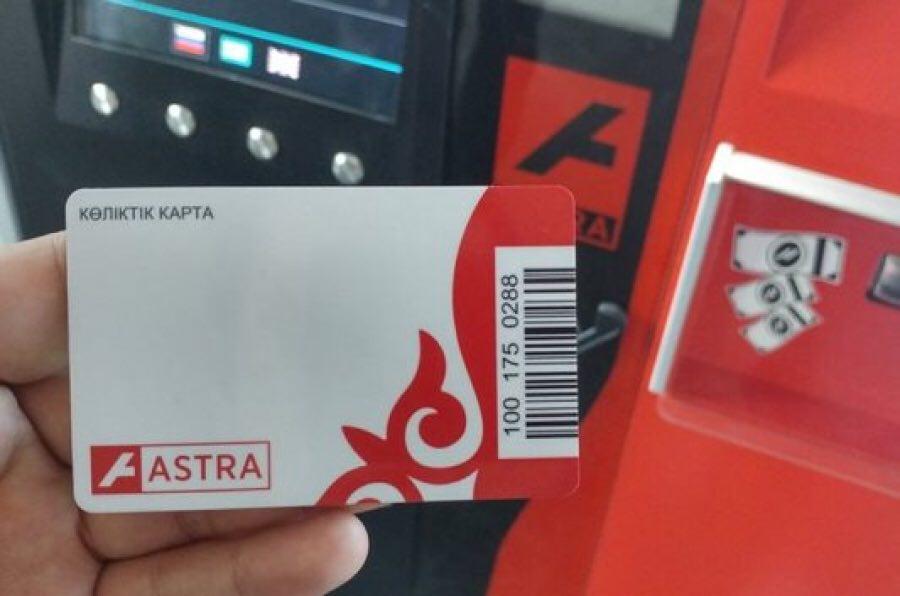
First, the preferential transport card is nominal and cannot be transferred to third parties for use.
Pensioners on age and length of service, as well as recipients of state social benefits for age and survivors who have reached retirement age, as well as mothers with many children; large families; disabled persons; children with disabilities up to the age of eighteen; including one of the parents (legal representatives), as well as participants and invalids of the Great Patriotic War and persons equated to them are exempt from payment for travel on urban passenger transport routes.
Second, preferential transport cards for travel on urban and express routes do not require replenishment and have no restrictions on the number of trips. However, it should be noted that despite the fact that citizens of a preferential category do not pay for travel, there are no trips on their maps, they must register trips by attaching a transport card to the validator at the entrance to the bus salon. This is because the registration of the trip is necessary for the correct calculation of subsidies. Akimat of the city partially reimburses the costs of carriers (vehicle fleets) for the transportation of a privileged category of citizens. Thanks to the system and validators, an accurate calculation is available on how many passengers have transported this or that vehicle fleet. This allows to calculate the exact number of trips for which the akimat will pay to fleets.
In addition, mandatory validation will help to conduct a clear analysis of passenger traffic. Based on this analysis, the route networks are improved: new routes are being changed and added, work is underway to unload the most sought-after routes.
At the moment, about 120,000 preferential categories of citizens are registered in Astana, 100,000 beneficiaries have already received personalized transport cards.
It should also be borne in mind that the school transport card as well as the preferential one is nominal and cannot be transferred to third parties for use. Children between the ages of 7 and 15 are eligible for a school transport card. The fare for users of the children's personalized transport card, which have not reached the age of 15, is 40 tenge.
The student receives the transport card at the educational institution where he studies. For registration of the card to the pupil, it is necessary to give the birth certificate and a photo. The initial issue of the card is free. If the school card is lost, re-release will cost 400 tenge.
If the school refused to issue a card, the parent or guardian can independently apply to the Department of Payment Systems, at Kazhimukana Str., 14. It is necessary to have the original birth certificate of the child, the identity card of one of the parents, a photo of the child of 3*4 size (in case the child is not present).
Also, a non-resident children's school can buy a registered school transport card, addressed to the issuance point accompanied by their parents or legal representatives, paying the cost of 400 tenge. The address of the Central cash desk: Kazhimukana Str., etc. 14. Cash desk: Mon-Fri from 9:00 to 18:00 without a break.
More than 120,000 school transport cards have already been issued.
In order to understand what the ticket price for public transport consists of, one should keep in mind that there are calculated and established tariffs. The settlement tariff reflects the real cost of travel. It takes into account the costs of the carrier for the maintenance of routes. These costs include fuel, repairs and maintenance, driver and conductor’s salaries, number of passengers, etc. The formation of tariffs is also influenced by such factors as rising prices for fuel, bus parts and consumables, as well as rising consumer prices, which in its turn affects the level of wages in the whole country.
When the commission considered reports and proposals submitted by carriers (vehicle fleets), the estimated tariff was determined at 301 tenge for travel in urban routes. But the established tariff, i.е. the one that will be the cost of the ticket for passengers is planned to be set at 200 tenge when paying in cash. The rest will be covered by subsidies from the state. That is, the state will pay a third of the real cost of travel.
In August 2014, the fare in the city bus increased by 30%. In four years the number of routes increased from 54 to 63. Suburban residents now get to work with comfort on public transport.
At the same time, the number of daily buses on the bus line increased by 22%. The average interval on the routes also decreased. All this became possible due to the acquisition of new comfortable, compliant buses.
A total of 738 buses were purchased: 358 in 2014 and 380 in 2017.
In addition, an electronic payment system was introduced, which allows to minimize the shadow turnover of funds, take into account the passenger flow, which in turn allows to see the real incomes of the carriers, as well as plan routes and calculate the amounts of subsidies correctly.
Increase of prices for public transport is necessary for the quality functioning of existing carriers. Establishment of fair fares for travel will allow to direct money for the development of public transport, the renewal of rolling stock, the improvement of passenger transportation services. To date, there is a need for 958 rolling stocks (including a 20% reserve).
In turn, the introduction of a differentiated tariff: the base tariff of 120 tenge when paid by a transport card and 200 tenge when paid in cash, will encourage residents of the capital to use the electronic system, which will increase revenues to the budget, minimizing the shadow turnover of funds. All this in the future will bear fruit in the form of better services and passenger transportation, corresponding to the level of the capital.
Speaking about the development of the public transport system in general, we should also highlight a number of projects aimed at improving the efficiency of public transport. So, the Bus Lane project implies a special dedicated lane on the streets of the city, which is designed for unhindered traffic of public transport. Bus Lane reduces the travel time of passengers along the routes, creates a public transport network with unhindered traffic, and popularizes public transport.
Expected effect:
The introduction of Bus Lane on the routes of city buses improves the work of public transport, namely, reduces the downtime of buses in traffic jams, simplifies the management of public transport in the general flow, reduces the number of irregularities on the schedule, and so on.
To date, 2 phases of the Bus Lane project have been implemented:
I Stage – 2015-2016. Special “Bus Lane" strips were introduced in 11 main streets of Astana, with a total length of 38.4 km. The effectiveness of the introduction of Bus Lane on these streets is 9%.
II Stage – 2017 Special buses "Bus Lane" were introduced in 12 main streets of the city, with a total length of 36.7 km. The effectiveness – 11%.
Thus, the overall efficiency of the implementation of the two phases of Bus Lane was 10%.
III Stage. Special Bus Lane strips are laid on the Kosshygululy Street (from street Oral to street Kumisbekova). It is also planned to introduce special bus lanes on six main streets of Astana, with a total length of 11.2 km.
The planned implementation efficiency of Bus Lane on these streets is 8%.
Also, the issue of updating the bus fleet is urgent for today. So, the City Bus project is aimed at updating the rolling stock of the city bus fleet. To date, projects have implemented and updated about 70% of all buses. Today there are 1,130 buses in the bus park of the city. Purchased buses meet all European quality standards, and are made taking into account the peculiarities of the weather and climate conditions of Astana (equipped with additional heating equipment, double insulating glass, insulated floor, etc., GPS-system). In total, nine motor vehicles operate in Astana.
Astana is a rapidly growing city, and in the near future the number of its residents will approach 2 million. Under such conditions, existing land passenger transport may not be sufficient to provide all users of public transport. The purpose of the light rail project (LRT) is the creation of an efficient harmoniously functioning system, which is the basis of the transport system of the city of Astana and includes all types of public transport. The length of the system is 22.4 km. In total, 18 stations will be built. The deadline for the project is December 2019.
The components of the new transport system of the city will provide significant benefits to the city:
1) greater mobility on the main corridors;
2) shorter and guaranteed travel time (LRT speed is much higher than in existing land passenger public transport);
3) reliable continuous service of passengers, thanks to the use of a dedicated route;
4) reduction of vehicles on roads, which leads to less congestion and higher commercial speed;
5) the ability to create an improved and fully integrated terrestrial public transport network, using existing vehicles as a feeding LRT.
6) prestigious attractive technology;
7) technology, harmless to the environment, less noise, less energy consumption;
8) improved transport safety and reduced number and severity of road accidents.
The estimated demand for passenger traffic in the period of entering the LRT will be 146,000 passengers per day. All of the above factors relieve the existing load of highways by 30% in certain areas.
Summing up, it should be noted that in order to increase attractiveness, public transport must meet all modern technological requirements, which is what all the implemented projects are aimed at.



Stay updated about the events of the Prime minister and the Government of Kazakhstan - subscribe to the official Telegram channel
Subscribe