06 October 2026, 10:30
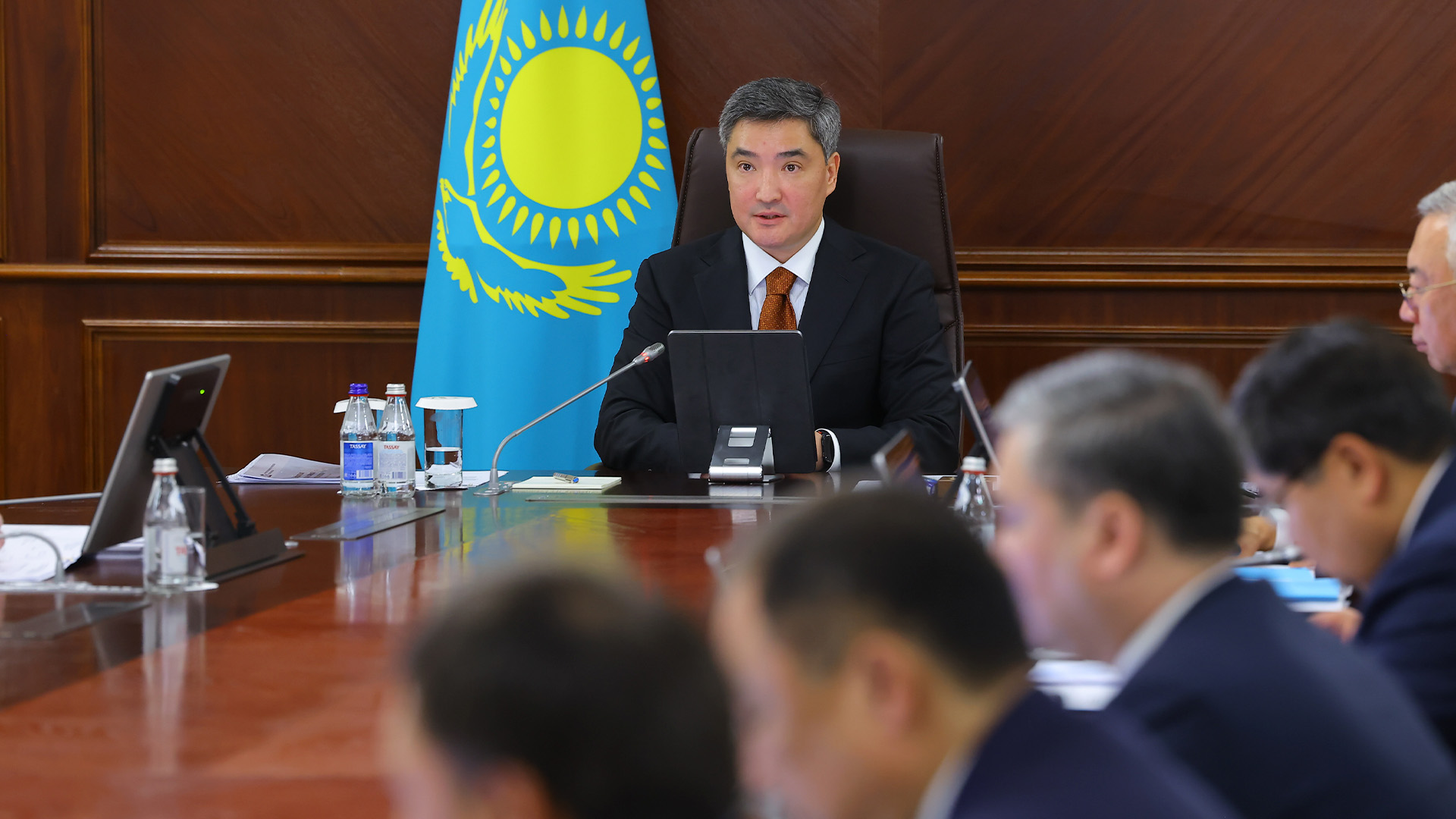 At the Government session chaired by Prime Minister Olzhas Bektenov, the progress of implementing the "Digital Qazaqstan" national strategy was reviewed.
Deputy Prime Minister and Minister of Artificial Intelligence and Digital Development Zhaslan Madiyev reported on the main directions for executing the document. Reports on sector-specific digitalization were delivered by Minister of Energy Yerlan Akkenzhenov, Minister of Industry and Construction Yersaiyn Nagaspayev, Minister of Agriculture Aidarbek Saparov, Minister of Transport Nurlan Sauranbayev, as well as the leadership of JSC "NC "KazMunayGas" and JSC "Kazakhstan Temir Zholy".
Adopted by Decree of Head of State Kassym-Jomart Tokayev, the "Digital Qazaqstan" national strategy initiates a large-scale transformation of key sectors of the economy and public administration based on digitalization and artificial intelligence.
"As the Head of State noted, digital technologies and the application of artificial intelligence are fundamentally transforming all sectors of the economy and the very lifestyle of citizens. Therefore, new technologies and services must develop at an accelerated pace. We approached the start of the Digital Qazaqstan strategy's implementation with a significant digital foundation, a high level of internet coverage across the country, and widespread use of electronic services. This foundation enables us to transition from digitalizing individual processes to a unified system for a large-scale digital model of state development," Olzhas Bektenov emphasized.
Today in Kazakhstan, the format of public service delivery has been substantially simplified, with many services available with a "single click". The Prime Minister instructed the Ministry of Artificial Intelligence to step up the pace of work. The public services ecosystem must evolve proactively so that citizens do not need to submit numerous requests, while avoiding excess bureaucracy in the digital realm.
In the energy sector, the need to continue digitalizing the power grid was highlighted. The Ministry of Energy must ensure the integration of key facilities and information systems into a single digital contour, with data outputted to the Energy Command Center. By the end of this year, a digital inventory of key facilities must be conducted and unified requirements for the composition, quality, and transmission of sectoral data must be approved.
In the oil and gas sector, the implementation of artificial intelligence technologies and digital twins must become the basic standard for production process management. The Ministry of Energy, together with the "Samruk-Kazyna" fund and "KazMunayGas", must ensure the scaling of these solutions across all production assets. By the end of 2028, a full launch of digital twins across 12 major fields must be secured.
As part of the digital transformation of industry, the Ministry of Industry needs to scale digital solutions across the entire sector, unifying key operational data into a single industry Data Lake. This should serve as the foundation for the widespread deployment of artificial intelligence, productivity growth, cost reduction, and increased competitiveness.
The Head of Government emphasized the need to build sustainable domestic demand for Kazakhstani digital solutions. Within two months, the Ministry of Industry was instructed to define a list of priority enterprises and technological processes for the primary implementation of domestic digital solutions. Furthermore, together with interested state agencies and national companies, it must formulate long-term demand for domestic robotic and unmanned solutions.
Agro-industrial complex (AIC) digitalization must reach a new level by consolidating key sectoral data into a single system, ranging from land conditions and production to state support and product distribution. In this regard, the Ministry of Agriculture must accelerate the development of a unified national digital ecosystem where all core processes and data will be interconnected. A transition is required from fragmented sector administration to data-driven agricultural management. Within one month, the Ministry of Agriculture was instructed to determine specific state support measures to be converted on a priority basis into a proactive format using digital profile data of farms.
Amid accelerated urbanization, the pressure on transport infrastructure is growing. The Ministry of Transport must build a unified nationwide digital transport system that will ensure a complete accounting of transport assets and enable real-time traffic management, load forecasting, and risk identification. Additionally, within two months, the Ministry of Transport, together with local executive bodies (akimats), was tasked with identifying the most congested transport bottlenecks in major cities and launching a pilot for intelligent traffic flow management, subsequently scaling up the most effective solutions. KTZ must complete the transfer of freight transport data to the unified data lake within one month and, together with the Ministry of Transport, approve a phased plan for the company's digital development, with a mandatory shift to domestic transport management technologies.
Special attention is required for the digital transformation of the financial sphere. Budget planning, treasury execution, state asset management, and auditing must be linked in a single digital contour. The focus should shift from logging violations post-factum to prevention, making decisions on budgetary funds and state assets based on predictive analytics. The digital tenge should become one of the tools of this system, providing end-to-end traceability of budget funds and the application of smart contracts.
Ultimately, it is necessary to move from post-factum control to real-time control directly at the moment of payment. Tax administration for citizens and businesses must become as seamless and service-oriented as possible: taxes should be calculated automatically, reporting pre-filled, and control focused primarily on real risks. Within two months, the Ministry of Finance must identify priority budgetary, tax, and control processes where decisions can be made automatically based on state data and risk models, and proceed with their practical implementation.
The Prime Minister also noted the necessity of ensuring a systematic execution of the "Digital Qazaqstan" strategy.
"The Digital Qazaqstan strategy must be clearly linked to the state planning system. The Ministry of Artificial Intelligence, together with the Agency for Strategic Planning, must decompose the strategy's target indicators across all development plans of state bodies, regions, and quasi-state sector organizations by the end of the current year. The strategy's implementation should be evaluated not by the number of launched projects, but by the actual achievement of set indicators," Olzhas Bektenov stressed.
Particular attention was paid to ensuring consistency across digital and AI projects of state agencies. Within two months, the Ministry of Artificial Intelligence must conduct a review of ongoing and planned digital projects, identify duplicate solutions, and ensure their consolidation on a single architecture and shared government platforms. This will concentrate resources on meaningful projects and eliminate duplicate funding for identical functionality.
"Executing the strategy will require significant financial and technological resources. At the same time, we must not allow them to be scattered across a large number of disjointed initiatives," Olzhas Bektenov emphasized.
The Ministry of Artificial Intelligence, together with the Ministry of Finance, was instructed to prioritize digital projects by the end of the year. Priority funding must be guaranteed for solutions that directly impact the achievement of the strategy's indicators. All new budget applications for digitalization must be evaluated based on their alignment with Digital Qazaqstan's architecture and priorities, as well as their expected economic impact. Projects, metrics, deadlines, and responsible executives have been assigned to each area of the strategy, with top heads bearing personal responsibility for achieving set outcomes.
Overall control and coordination are assigned to Deputy Prime Minister and Minister of Artificial Intelligence and Digital Development Zhaslan Madiyev.
#Olzhas Bektenov #The Prime Minister of the Republic of Kazakhstan #Artificial intelligence #Government session



Stay updated about the events of the Prime minister and the Government of Kazakhstan - subscribe to the official Telegram channel
Subscribe