15 January 2026, 18:07
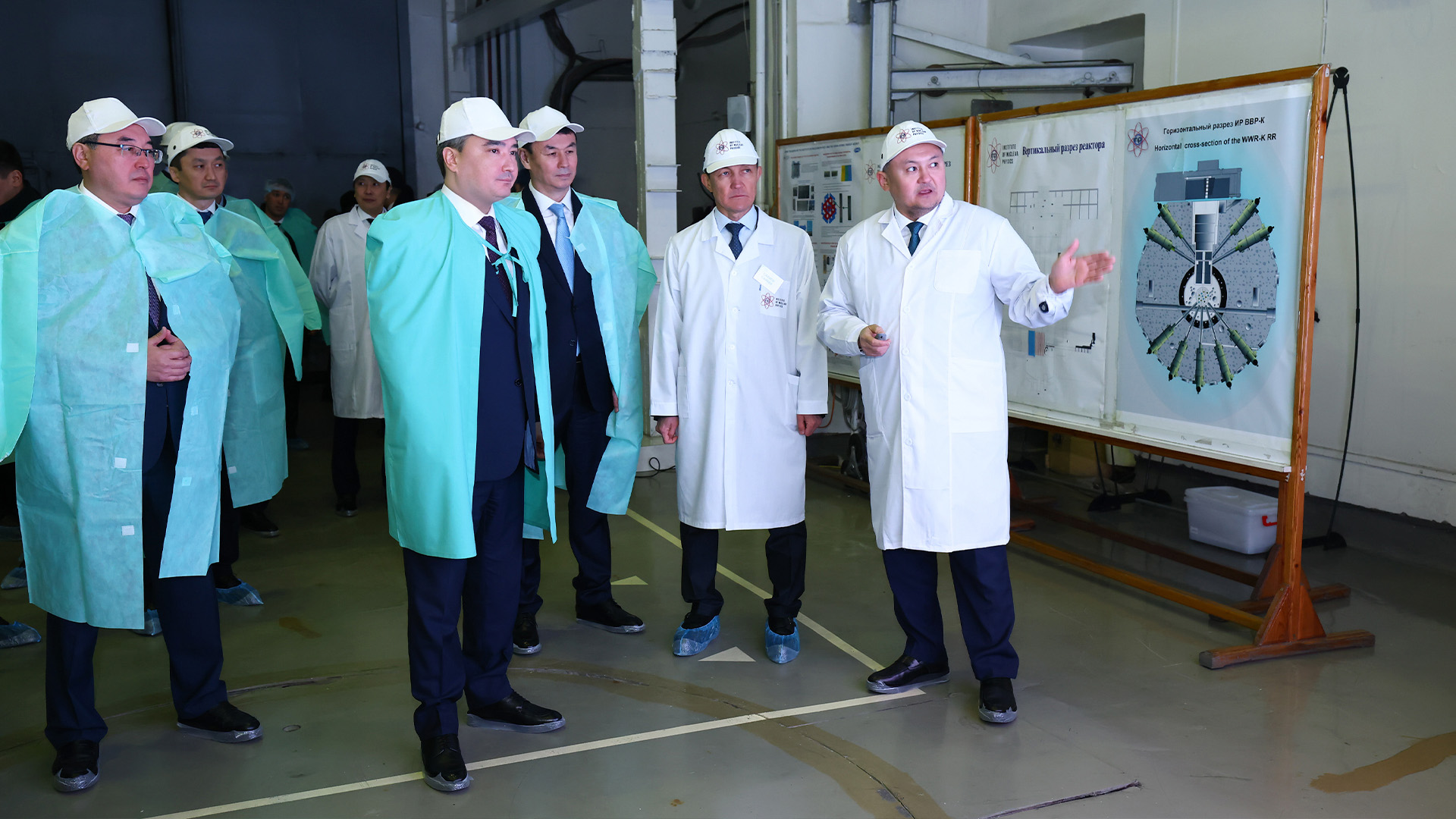
Prime Minister Olzhas Bektenov, during a working trip, reviewed the implementation of the Head of State’s instructions on developing scientific, applied, and high-tech areas in the nuclear industry. The key objective is the formation of research infrastructure and the strengthening of the sector’s scientific and technological potential.
In Almaty, Olzhas Bektenov visited the Institute of Nuclear Physics (INP) of the Agency of the Republic of Kazakhstan for Atomic Energy and familiarized himself with the operation of key facilities and production sites. The Institute conducts testing of materials for next-generation nuclear reactors and thermonuclear installations, applies nuclear technologies in industry, scientific research, and medicine, including the production of vital radiopharmaceuticals for the diagnosis and treatment of oncological diseases. Currently, 11 basic experimental facilities operate at the INP, including the VVR-K research reactor, a critical assembly, storage facilities for radioactive waste and spent ionizing radiation sources, as well as six charged-particle accelerator complexes.
Based on the VVR-K research reactor and the Cyclone-30 cyclotron, Kazakhstan’s only production of reactor-based radiopharmaceuticals accredited under the international GMP standard has been established. At present, the Institute produces and supplies three radiopharmaceuticals to medical centers across Kazakhstan, including those based on iodine-131 and molybdenum-99/technetium-99m. Iodine-131 is used to treat thyroid diseases, including oncological conditions, while technetium-99m is used for diagnosing diseases of almost all human organs and systems. Technetium-99m generators are also manufactured at the INP, with the production technology patented by the Institute. Overall, the product range covers key isotopes for the diagnosis of oncological and cardiovascular diseases and for the treatment of thyroid cancer, with the Institute meeting around 85% of the country’s demand for radiopharmaceuticals. The Cyclone-30 is designed for the industrial production of radioisotopes and is currently almost fully loaded with the production of fluorine-18 for PET diagnostics, demand for which in Kazakhstan continues to grow steadily.
 Olzhas Bektenov was shown operations involving highly active radioactive materials in “hot cells” — shielded boxes with viewing windows and remote manipulators that ensure safe handling of irradiated materials. The complex includes five cells, each responsible for a separate stage, including dismantling irradiated devices, cutting, welding, testing radiation sources, and processing radioisotopes. Director General of the Institute of Nuclear Physics Sayabek Sakhiev noted that INP products are used annually for the treatment and diagnosis of more than 18,000 patients, while industrial radioisotopes are exported to European countries, the United States, and Central Asia. The Institute is also implementing investment projects to localize the production of strategically important radioisotopes, including molybdenum-99 using the fission method and lutetium-177, and is developing commercial areas of activity.
The Prime Minister was also briefed on industrial isotope products. The Institute is the country’s sole producer of ionizing radiation sources (cobalt-57, iridium-192, antimony-124). Cobalt-57 is currently exported to Germany, France, and Russia.
It was emphasized that the Institute’s scientific and technical base, taking into account its modernization and expansion, serves as the foundation for the development of the country’s nuclear cluster and a science city in Almaty Region.
 During the working trip, Minister of Science and Higher Education Sayasat Nurbek reported on the Concept for the creation and development of knowledge-intensive territories. One of the pilot locations has been designated at the site of the Institute of Nuclear Physics in Almaty Region.
The project предусматривает the creation of a science and technology park focused on strengthening human capital, modernizing scientific infrastructure, commercializing developments, and launching high-tech production. Expected results include attracting more than 400 scientific specialists and expanding the patent base.
Currently, the INP cooperates with more than 30 organizations, including CERN, IAEA, MIT, Joint Institute for Nuclear Research, and others. The Institute operates training centers that have prepared more than 4,500 specialists, and plans are in place to open a regional nuclear forensics training center in 2026.
In this regard, to create conditions for learning and accommodation, a dormitory equipped with study and work spaces was built at the end of last year. The Prime Minister inspected the seven-story building designed for 166 students and specialists. It was noted that the project’s implementation contributes to the formation of a sustainable educational environment, the attraction and retention of qualified personnel, and the development of scientific potential within the framework of Kazakhstan’s nuclear cluster projects.
#Olzhas Bektenov #The Prime Minister of the Republic of Kazakhstan #Nuclear power #President's instruction



Stay updated about the events of the Prime minister and the Government of Kazakhstan - subscribe to the official Telegram channel
Subscribe