01 July 2026, 11:10
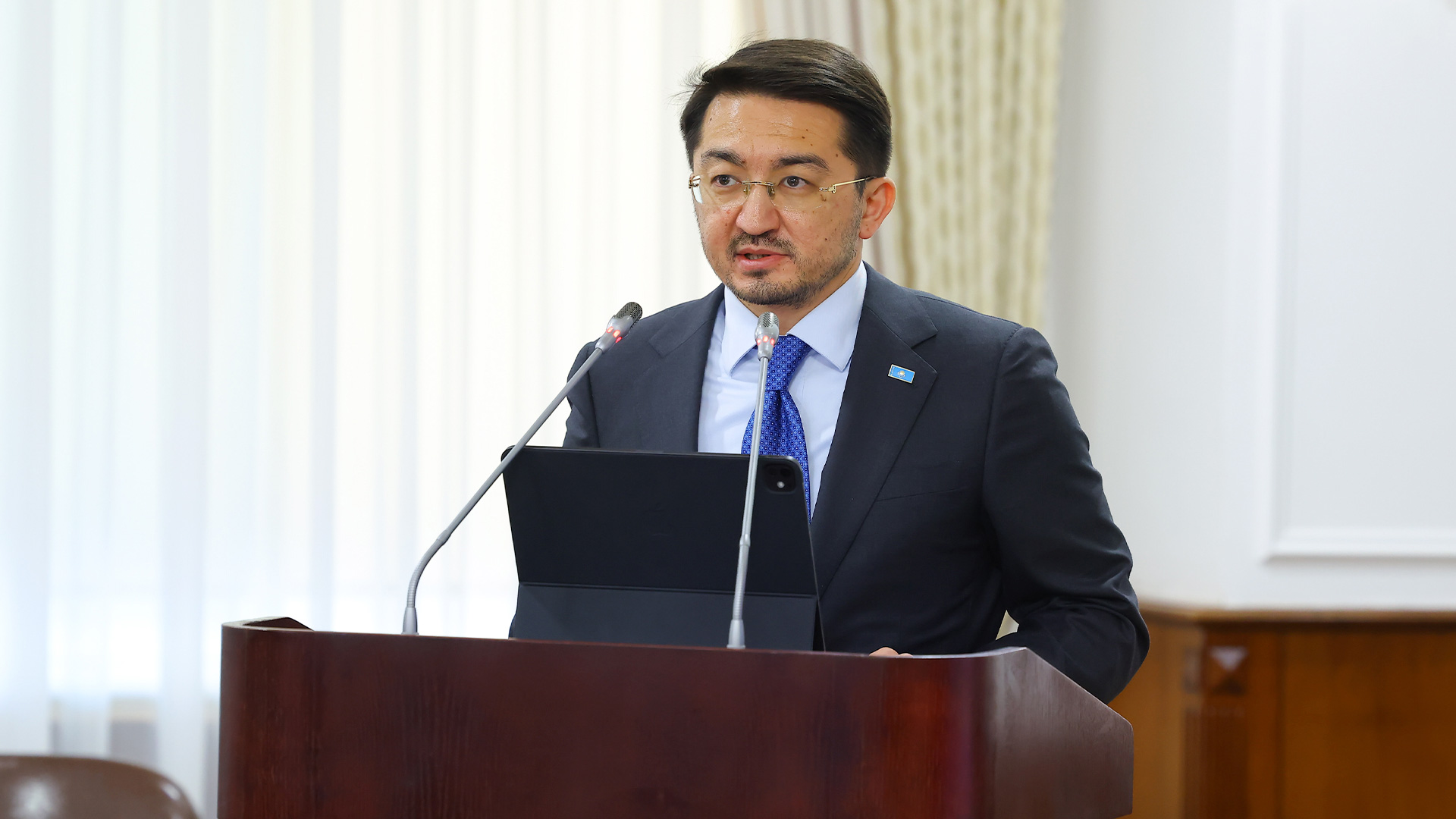 Deputy Prime Minister – Minister of Artificial Intelligence and Digital Development Zhaslan Madiyev reported at a Government meeting on the work being carried out to digitalize economic sectors and the public administration system.
He noted that over the past 6 months, the country has rapidly formed the regulatory and institutional foundation for Kazakhstan’s digital future. Kazakhstan’s citizens have adopted a new Constitution. It enshrines the digital rights of citizens, including the right to protection of personal data. The special status of Alatau City has been enshrined at the constitutional level. The Digital Code, the Law “On Artificial Intelligence,” the Law “On Digital Assets,” the Law “On Cybersecurity,” as well as the Law on the Development of the Telecommunications and Data Center Market have been adopted. On June 9 of this year, the Head of State approved the National Strategy Digital Qazaqstan until 2029.
“This is our comprehensive roadmap for digital transformation and large-scale implementation of AI in economic sectors and public administration,” Zhaslan Madiyev emphasized.
It was noted that last year the first supercomputer clusters in the region were launched. They entered the global TOP 500 ranking of the most powerful supercomputers. Today, their capacities are used by startups, universities, research institutes, government agencies, and companies. This year, construction of a world-class Data Center Valley began. Its target capacity will be at least 1 GW. By 2028, 92% of villages will be covered by high-speed internet. A 5G network is being developed in 20 major cities. Construction of a hyper-mainline stretching over 4 thousand km continues. 40 thousand km of republican and regional roads will be provided with communication. Full coverage of the country’s territory is ensured through satellite internet.
The country is building a continuous trajectory for training its own specialists. For example, TUMO is a creative technologies center for children aged 12–18. For the adult audience, there is Tomorrow School, focused on training practical AI specialists.
It was noted that the next stage will be the launch on September 1 of this year of the Kazakhstani Research AI University – Qazaq AI Research University.
Systematic work is being carried out on the digital transformation of public administration. AI tools are being introduced. The National Artificial Intelligence Platform is used for developing AI agents, translations, protocoling, and preparing official correspondence.
More than 2 million citizen appeals have already been processed using artificial intelligence in e-Otinish AI. The full launch of the unified QazTech platform has been carried out. Since the beginning of the year, a moratorium on development outside the platform has been introduced. By the end of 2027, the migration of 108 information systems of central government agencies is planned. A new generation of eGov and eGov Business is being developed. Public service centers will be transformed into Digital Population Offices. The national AITU ecosystem is developing as a single communication channel between citizens and the state. A test version of the e-Parliament platform has been deployed. Adaptation to the new model of the legislative process is underway, taking into account the unicameral Kurultai.
The Ministry of Artificial Intelligence and Digital Development is transitioning to the systemic AI transformation of internal processes. 151 business processes have been reengineered. 300 employees of the department have been trained in AI skills. Internal competence is being formed for further independent development and adaptation of AI solutions. More than 180 employees have completed training in vibe coding.
The Deputy Prime Minister emphasized that Kazakhstan is strengthening its status as a high-tech and business hub in Eurasia. Alem.ai has already become one of the key platforms for technological diplomacy. The center has been visited by more than 40 official delegations, heads of state, and leaders of leading international companies. Kazakhstan has also received recognition in the United Nations system. In April of this year, at the 82nd session of UN ESCAP in Bangkok, a historic resolution was adopted. In accordance with it, a Digital Solutions Center will be established in Almaty.
A separate area is Alatau City. An innovative city of a new generation that will become a sandbox for the implementation of promising technologies. A special legal regime has been adopted. Kazakhstan has joined the US Pax Silica initiative and the AI Opportunity Partnership and has entered the club of AI economies.
#Digitalization #Government session #President's instruction“This will allow Kazakhstan to integrate into the global value chain in the field of semiconductors, chips, batteries, and processing of critical minerals. That is, to move from raw material exports to higher value-added products,” Zhaslan Madiyev concluded.



Stay updated about the events of the Prime minister and the Government of Kazakhstan - subscribe to the official Telegram channel
Subscribe