31 March 2026, 12:10
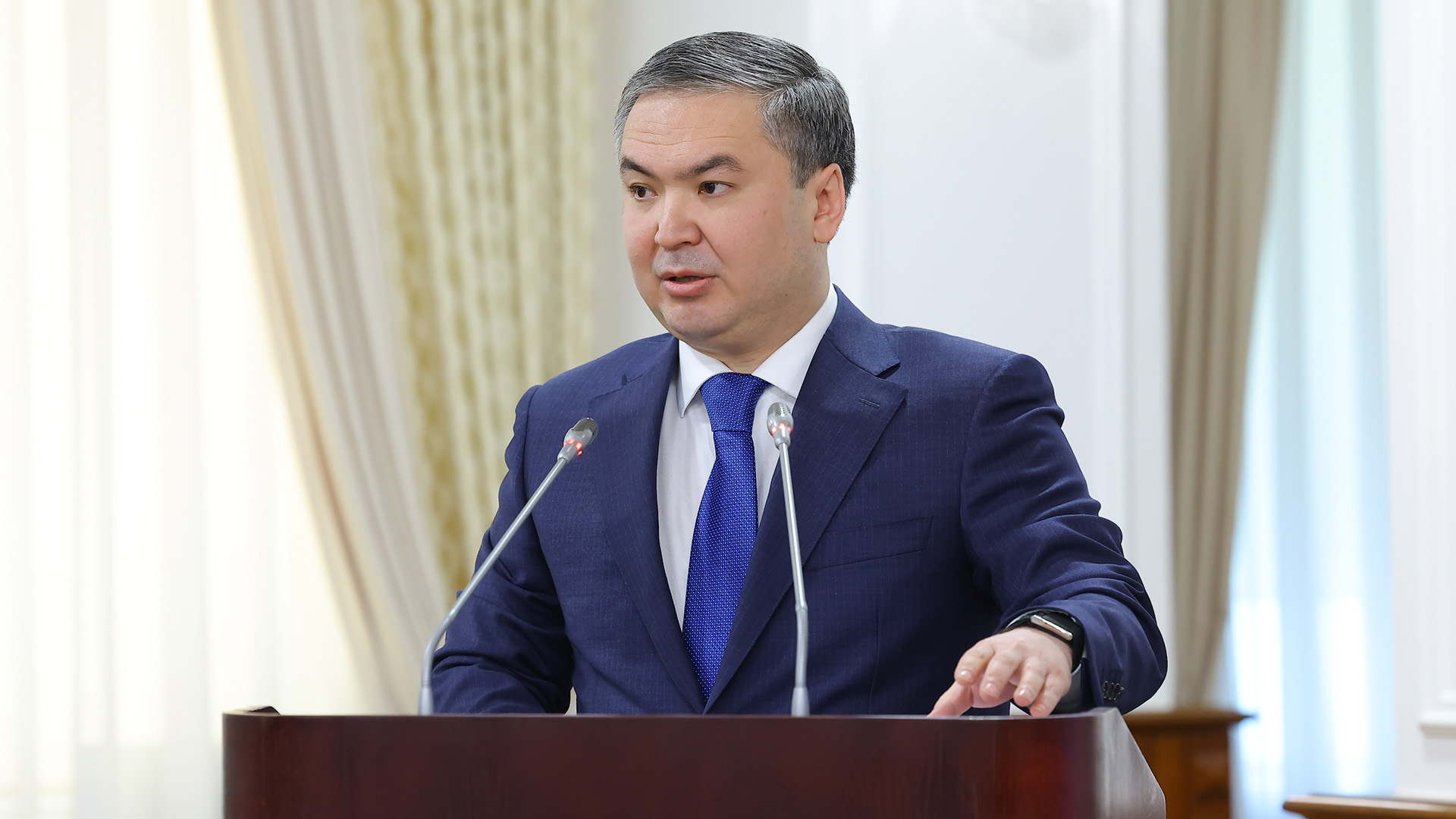 Minister of Industry and Construction of the Republic of Kazakhstan Yersaiyn Nagaspayev reported at the Government session on the ongoing work to introduce robots into industrial production.
He noted that the development of innovation and technological modernization is one of the key directions of industrial policy.
The Law on Industrial Policy identifies digital transformation, the introduction of Industry 4.0 technologies, the development of industrial infrastructure, and the stimulation of investment in enterprise modernization as priorities.
“The implementation of these measures is already yielding concrete results. Enterprises’ spending on innovation has increased 4.5 times compared to 2021 and reached 1.9 trillion tenge,” Yersaiyn Nagaspayev said.
It was noted that an innovative geochemical method is being introduced in the geological sector to search for hidden ore deposits located deep underground and undetectable by traditional methods.
The method detects weak traces of metals in the soil, allowing specialists to determine the presence of mineral deposits.
The obtained data is visualized in 2D and 3D models, which makes it possible to more accurately identify promising areas for exploration.
In mining metallurgy, innovative solutions are being implemented to improve the efficiency of raw material processing and to involve low-grade and man-made resources.
The main volume of funding for such work is formed through mandatory contributions from subsoil users at the rate of 1% of extraction costs.
Priority areas of scientific and technological development are determined by the Scientific and Technical Council established under the Ministry.
Over the past five years, large enterprises in the mining and metallurgical sector have invested about 150 billion tenge in research and development, implementing more than 1,500 projects. These developments are aimed at solving specific production tasks.
Scientific research is carried out with the involvement of Kazakhstani and foreign scientific organizations and engineering companies, as well as through the companies’ own research centers, and, if necessary, with the involvement of external scientific organizations.
A significant part of the projects is implemented by Kazakhstani scientific organizations and universities, which contributes to the development of national scientific schools and personnel training.
For example, at the Ayak-Kodzhan, Aktogay, and Almaly deposits, as well as at the Kounrad dumps and Bozshakol factories, combined enrichment-hydrometallurgical technologies for processing low-grade copper-containing raw materials are used, ensuring the production of more than 50,000 tons of cathode copper per year with sales of up to $350 million.
At the Berkara complex, heap leaching technology has been introduced, enabling the enterprise to reach its design capacity of up to 5,000 tons of cathode copper per year. Hydrometallurgical processing of vanadium-containing quartzites from Karatau has also been implemented, achieving vanadium recovery of more than 85% and molybdenum recovery of more than 77%.
The technology for mining and processing scheelite ores at the Boguty deposit has been optimized. As a result, a plant for processing tungsten ores was launched, with additional production of up to 100 tons of tungsten trioxide per year.
At the Balkhash Copper Smelter, a technology for reductive electric smelting has been developed for the complex extraction of associated components, allowing the processing of more than one thousand tons of precious metal slag per year.
At “Zhezqazganredmet”, a technology for recycling secondary raw materials from heat-resistant nickel alloys has been introduced, increasing rhenium output tenfold while additionally extracting nickel, cobalt, and other alloying elements.
“Today, an innovative ecosystem is being formed with an emphasis on digital transformation, support for startups, and the introduction of modern technologies. A technological maturity assessment of 500 industrial enterprises was carried out, resulting in 23 recommendations for modernizing production processes. 240 employees underwent training in the implementation of digital technologies,” Yersaiyn Nagaspayev added.
According to the Ministry, 11 pilot projects using artificial intelligence have been implemented as part of the Roadmap for the Introduction of Artificial Intelligence.
In the development of innovation in mechanical engineering, one of the priorities is the robotization of production.
Currently, the density of industrial robots in the country is about 7 units per 10,000 workers, which is significantly lower than in leading countries of the world.
In this regard, active work has begun on the introduction of digital solutions, including automated control systems, data analytics, elements of artificial intelligence, digital platforms, as well as industrial robots and machine vision systems, in order to develop robotization and reduce the shortage of personnel in production.
In 2025, more than 300 robots, including FANUC and ABB, were installed. Examples include the KIA Qazaqstan plant with 68 robots and Astana Motors with 54 robots. In addition, in cooperation with the Ministry of Digital Development, within the framework of the national strategy “Digital Kazakhstan”, it is planned to establish a project office for the robotization of economic sectors.
#Government session #Industry #Innovation



Stay updated about the events of the Prime minister and the Government of Kazakhstan - subscribe to the official Telegram channel
Subscribe