07 October 2026, 08:05
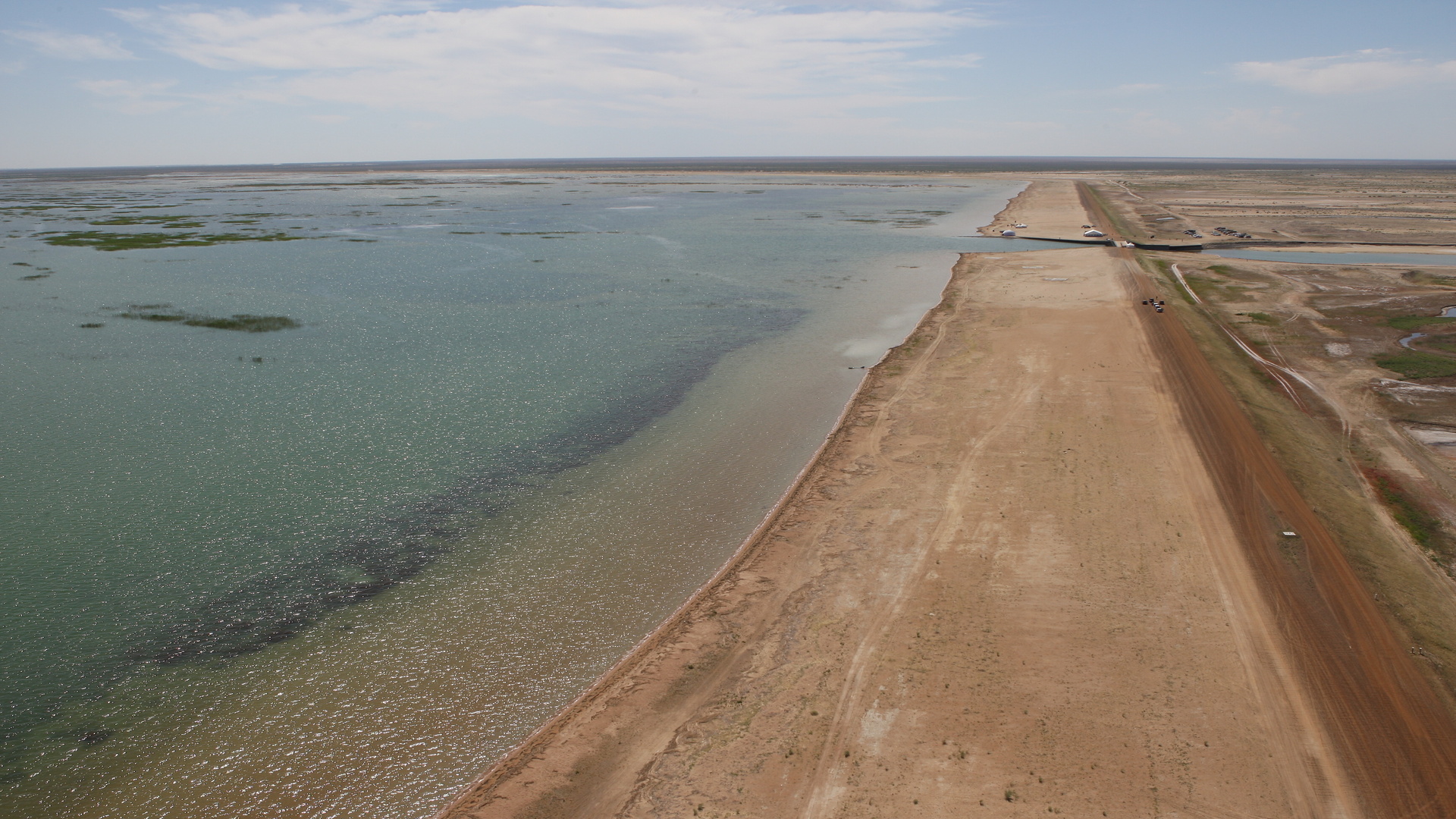 As part of implementing the directives of Head of State Kassym-Jomart Tokayev outlined in the State-of-the-Nation Address "Kazakhstan in the Era of Artificial Intelligence: Current Tasks and Solutions Through Digital Transformation," the Government is executing a comprehensive set of measures to restore the Northern Aral Sea and preserve the water resources of the Caspian Sea. Specifically, the President instructed the continuation of work on restoring the Aral Sea and, jointly with partner countries, the development of an interstate program to preserve the Caspian Sea.
The primary measures focus on developing and implementing solutions to increase water levels in these reservoirs, as well as preserving and restoring biodiversity. In parallel, scientific research on the flora and fauna of the Caspian Sea is being conducted, alongside efforts to combat desertification on the dried seabed of the Aral Sea.
Water Volume in the Northern Aral Sea Rises to 23.4 Billion m³
The volume of water in the Northern Aral Sea continues to grow, currently reaching 23.4 billion m³. For comparison, it stood at 18.9 billion m³ in 2022, 21 billion m³ in 2023, 22 billion m³ in 2024, and reached 23.4 billion m³ by the end of last year. Since the beginning of this year, approximately 1.5 billion m³ of water has been directed into the sea.
This positive trend is the result of systematic efforts that Kazakhstan has maintained for over 20 years. Over this period, the surface area of the Northern Aral Sea has expanded by 36%, its water volume has nearly doubled, and salinity levels have been cut in half. This has fostered the revival of aquatic organisms and the local ecosystem.
To sustain these metrics, the Ministry of Water Resources and Irrigation ensures an annual flow of no less than 2 billion m³ of water through the Syr Darya riverbed.
The Government has developed the next phase of the Northern Aral Sea restoration in collaboration with the World Bank. It includes the reconstruction of the Kokaral Dam and raising the water level to 44 meters above sea level (Baltic system). Over the next 5–6 years, the reservoir’s surface area is planned to increase to 3.9 thousand km², with the total water volume reaching 34 billion m³.
Concurrently, more than 160 projects aimed at modernizing and automating irrigation systems are planned for implementation in the Aral-Syr Darya basin across Turkestan and Kyzylorda regions. This will allow for more efficient water use and enable conserved water volumes to be redirected into the Northern Aral Sea.
Land Reclamation Area on the Dried Aral Seabed Reaches 1.1 Million Hectares
In addition to measures for raising water levels in the Northern Aral Sea, the Government is continuing land reclamation work on the dried seabed. On the Head of State’s directive, the total area of saksaul (haloxylon) plantations established here is targeted to reach 1–1.5 million hectares.
To date, 3.4 thousand tons of saksaul and halophyte seeds have been sown on the Aral seabed, along with the planting of 56.2 million saksaul saplings. The total area covered by land reclamation efforts has reached 1.1 million hectares.
To provide scientific support for these operations, a regional branch of the Kazakh Research Institute of Forestry and Agroforestry has been established. Simultaneously, an internal base for growing planting material is being built: construction of a 33-hectare forest nursery with a capacity of 3 million saplings per year has been completed.
Furthermore, a forest nursery is being set up directly on the dried seabed of the Aral Sea. Cultivating saplings under local arid conditions will improve their adaptation, survival rate, and overall quality.
Kazakhstan Strengthens Scientific and Interstate Cooperation on Caspian Sea Preservation
The Caspian Sea, located at the crossroads of Europe and Asia, is the world's largest enclosed body of water. It spans an area of approximately 390 thousand km², holds a water volume of around 76 thousand km³, and features a coastline extending 6.5 thousand km.
A total of 130 rivers empty into the Caspian Sea, delivering an average annual inflow of around 290 km³ of water. The bulk of this inflow comes from the Volga (around 80%) and the Ural (3.5%). Other major contributing rivers include the Kura, Sulak, and Samur.
In the Zhaiyq-Caspian basin, 6 km³ of water flowed from the Zhaiyq (Ural) River into the Caspian Sea in 2025, alongside 4.9 km³ from the Qighash River. In 2026, the combined inflow from these two rivers reached approximately 7.3 km³.
Kazakhstan consistently promotes joint approaches toward its conservation. At the expanded meeting of the Shanghai Cooperation Organisation (SCO) in 2025, President Kassym-Jomart Tokayev proposed the creation of an SCO Water Research Center.
Building on this initiative, Kazakhstan is preparing an interstate program for the preservation of the Caspian Sea and establishing a dedicated research institute. An interstate program for preserving the water resources of the Caspian Sea with the participation of all littoral states is also under preparation.
Practical measures for advancing international collaboration were discussed in Aktau during the High-Level Dialogue on the Caspian Sea, attended by government officials, diplomatic corps representatives, UN entities, international partners, scientists, and industry experts. Key discussions centered on declining sea levels, biodiversity conservation, combating pollution and marine debris, improving monitoring and data sharing, and securing international funding.
Launched within the framework of the Dialogue, the project "Enhancing Resilience Amidst Caspian Sea Level Decline" is being implemented with the support of the Government of Japan. The project utilizes scientific data and digital tools to assess and mitigate the impacts of the Caspian Sea's shrinking water levels.
In partnership with the UNDP and international stakeholders, a portfolio of projects is being formulated to manage marine and coastal resources, develop a circular economy, improve waste management systems, and reduce plastic pollution. A dedicated track focuses on preserving the Caspian's biodiversity, including the Caspian seal and its natural habitats.
Regarding transboundary water management, Kazakhstan has finalized its legal framework with all neighboring states. Bilateral commissions have been established and are actively functioning to ensure sustainable interaction and coordination in the shared use of water resources.
For instance, following ten years of negotiations, an agreement was signed last year with Uzbekistan on the joint management and rational use of transboundary water bodies.
Thanks to established water diplomacy and coordinated operational schedules for reservoirs along the Syr Darya, a stable inflow of water into the Northern Aral Sea has been maintained in recent years, even during dry periods.
#Digitalization #Ecology #President's instruction #water resources



Stay updated about the events of the Prime minister and the Government of Kazakhstan - subscribe to the official Telegram channel
Subscribe