11 August 2026, 11:30
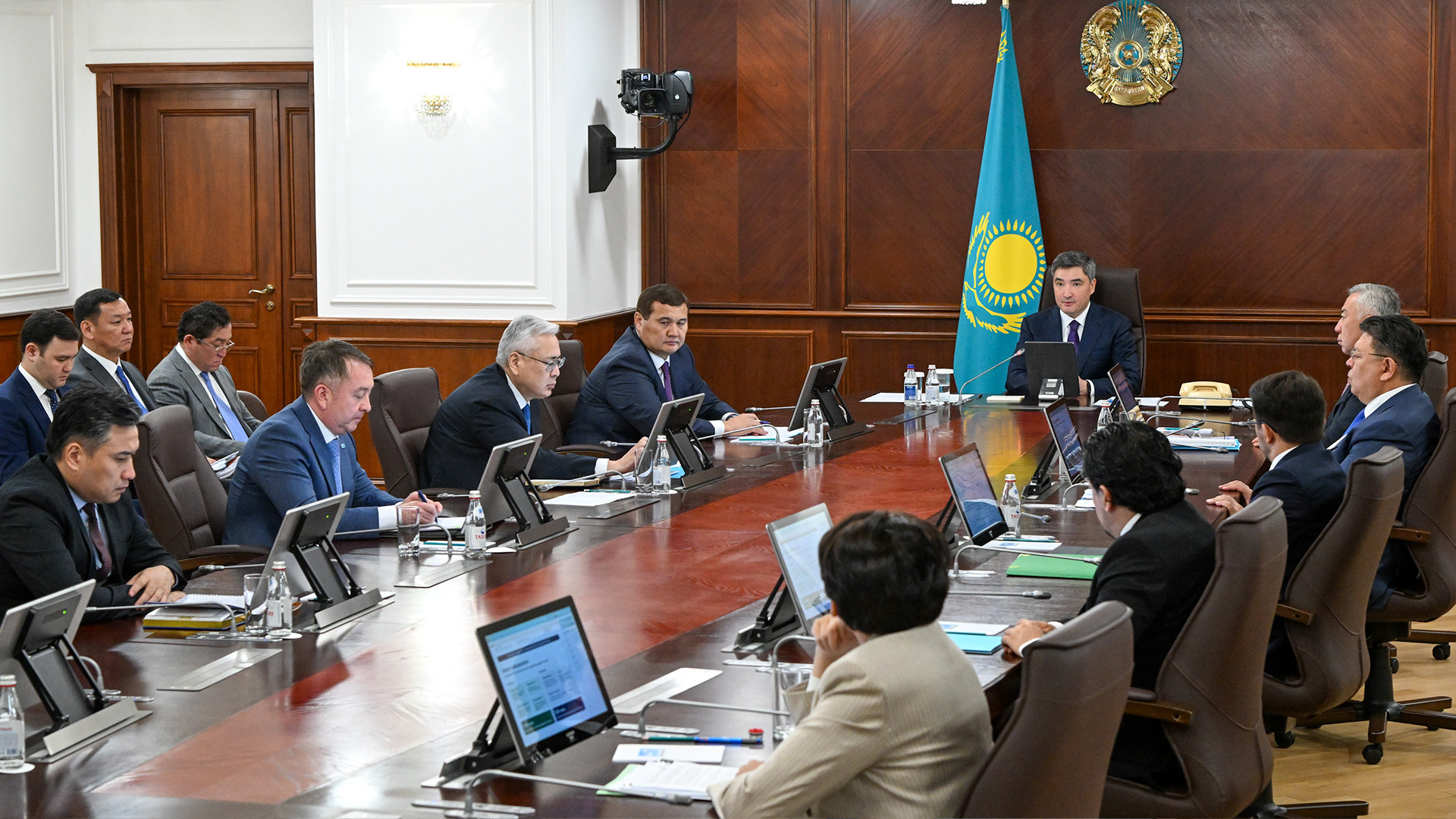 At the session of the Government chaired by Prime Minister of the Republic of Kazakhstan Olzhas Bektenov, issues related to the formation of a new ecosystem of public services based on artificial intelligence were considered. Attention was paid to the key directions for the further digitalization of public services and the introduction of AI into the interaction of the state with citizens and business. Reports were delivered by Deputy Prime Minister – Minister of Artificial Intelligence and Digital Development Zhaslan Madiyev, Minister of Labor and Social Protection of the Population Askarbek Yertayev, Minister of Justice Yerlan Sarsembayev, Deputy Minister of National Economy Bekbolat Moldabekov, as well as Chairperson of the Board of JSC “Otbasy Bank” Lyazzat Ibragimova and Head of BTS Digital Maksat Nuridenuly.
In Kazakhstan, within the framework of the tasks set by the Head of State, systemic digitalization of public services and the introduction of artificial intelligence technologies continue. Special significance is attached to this work by the declared Year of Digitalization and Artificial Intelligence. In June of this year, the nationwide strategy “Digital Qazaqstan” was approved, in which the digitalization of public services is defined as one of the key directions.
“The Head of State has set the task of large-scale introduction of advanced technologies and artificial intelligence into all spheres of public life, first of all, in the provision of public services for citizens and business. Artificial intelligence tools must not simply be integrated into decision-making processes; with their help a full-fledged digital ecosystem for the provision of public services must be formed. At the same time, the model of interaction between the state and the citizen must continue to be built on proactive decision-making,” Prime Minister Olzhas Bektenov emphasized.
Deputy Prime Minister – Minister of Artificial Intelligence and Digital Development Zhaslan Madiyev reported on the work being carried out. State information systems are being transferred to the unified QazTech platform, the e-government portal has been modernized to eGov 3.0, and the capacity of its gateway has been increased 2.5 times.
Through the digital assistant eGov GPT, 50 public services are currently available; the service has been used by more than 150 thousand citizens. The eGov Business system is used monthly by about 35 thousand entrepreneurs. Overall, the digitalization of high-demand services has made it possible to reduce the number of visits to Public Service Centers (TsONs) by 30%.
The Prime Minister instructed that by the end of the current year the number of public services available through eGov GPT be increased to 150.
In the social and labor sphere, digital services cover the main areas — from the assignment of pensions and benefits to employment and social support. On the unified digital platform, 49 public services are provided in electronic format, and another 28 are provided proactively. Artificial intelligence is used to assess housing and living conditions when assigning targeted social assistance — covering 99 thousand cases; when establishing disability — 151 thousand cases; and for the automatic provision of public services — 12 thousand cases.
In July, a “Digital Employment Service” was launched in the Pavlodar Region, allowing people to search for work online, undergo training, and receive support measures. A similar mechanism is planned to be launched in the Mangystau Region in September. The Ministry of Labor, together with the akimats, has been instructed to scale the service to all regions of the country by the end of the year.
In the justice sector, the digitalization of enforcement inscriptions has made it possible to transfer the main procedures to an online format through eGov Mobile. To date, more than 2.5 million enforcement inscriptions have been made, and about 700 thousand objections have been filed. By the end of the year, the launch of e-Notary 2.0 with digital recording of notarial actions is planned. In the area of business support, out of 150 existing measures, 63 have already been transferred to digital format. The Ministry of National Economy, together with the Atameken National Chamber of Entrepreneurs, has been instructed to re-engineer business support measures by the end of the year and bring them onto eGov Business.
In the permitting sphere, the task has been set to modernize the “Electronic Licensing” portal and transfer the relevant procedures to a more modern digital format. The Ministry of Artificial Intelligence, together with government agencies, has been instructed to complete this work within six months.
In the sphere of housing provision, more than 254 thousand operations have been carried out using Blockchain, which has made it possible to reduce the time for providing services to 10–15 minutes and eliminate the need to visit Public Service Centers.
The development of the domestic digital platform Aitu was considered. Today it unites 6.8 million users, while the monthly audience exceeds 1 million people. Access to services in the spheres of education, healthcare, social protection, and other services is being expanded on the platform.
Following consideration of the issue, Olzhas Bektenov outlined a number of priority directions for further digitalization.
First. Government agencies have been instructed to accelerate the migration and integration of information systems onto the unified QazTech platform. The Ministry of Artificial Intelligence will strengthen coordination of this work. The transition to a single technological base must ensure an end-to-end process for the provision of digital services to citizens.
Second. By the end of the current year, the transformation of Public Service Centers into AI offices with self-service express zones, expert zones, and zones for training citizens in the use of digital services must be completed in all regions. The corresponding work will be carried out by the akimats together with the Ministry of Artificial Intelligence and the state corporation “Government for Citizens.”
Third.
“Today citizens expect not simply an increase in the number of digital services. People want to quickly obtain the necessary result without complex searches and applications. I instruct the Ministry of Artificial Intelligence, together with interested government agencies, to determine the list of those services that can be transferred to an instant format of provision already this year. By analogy with the assignment of benefits to mothers of large families or the issuance of a certificate of the presence or absence of a criminal record,” the Prime Minister emphasized.
Fourth. The Ministry of National Economy, together with the akimats, has been instructed within a two-month period to transfer to digital format the services of natural monopoly entities, including procedures for connecting business facilities to utility infrastructure, and to ensure compliance with the established deadlines for their provision. The Ministry of Artificial Intelligence, together with interested government agencies and akimats, is to scale to all regions the mechanism of proactive conclusion of contracts by citizens with utility services.
Fifth. The Ministry of Artificial Intelligence, together with interested government agencies, has been instructed within one week to complete the coordination of the Action Plan for the implementation of the “Digital Qazaqstan” strategy and to submit the corresponding draft resolution to the Government.
Control and coordination of the execution of these instructions have been assigned to Deputy Prime Minister – Minister of Artificial Intelligence and Digital Development Zhaslan Madiyev.
#Olzhas Bektenov #Digitalization #Government session #Public Services



Stay updated about the events of the Prime minister and the Government of Kazakhstan - subscribe to the official Telegram channel
Subscribe