20 November 2026, 07:40
Kazakhstan Enters the UN Top 20 and Highest Rating Class for the First Time
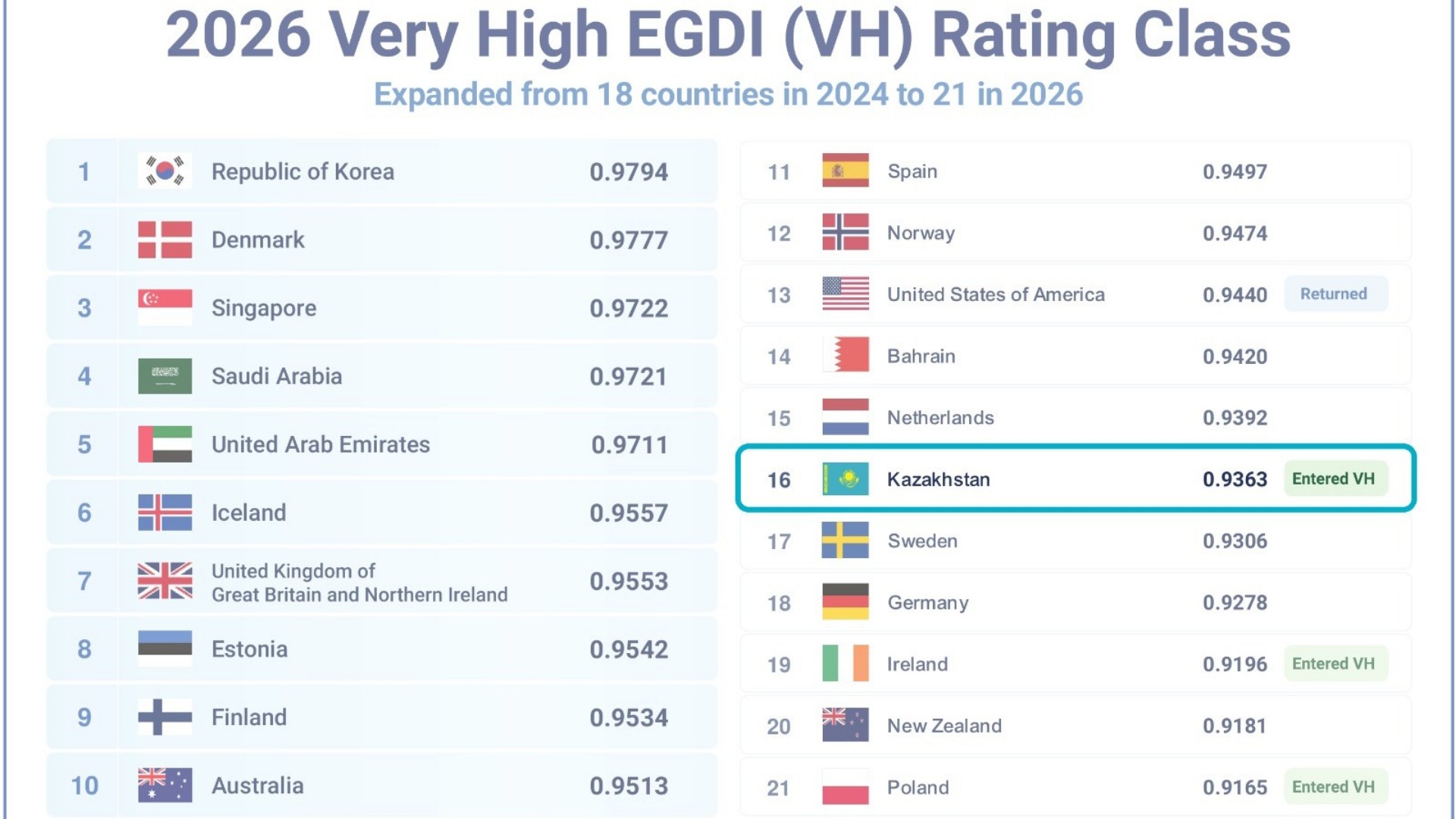
 Kazakhstan has climbed from 24th to 16th place in the United Nations E-Government Development Index (UN EGDI) and entered the highest rating class for the first time. Gaining 8 positions over two years, this rise was named in the UN report as one of the most significant among leading nations. Kazakhstan became the first country in the region to achieve this level. This result is a direct consequence of implementing the Head of State's instruction to transform Kazakhstan into a full-fledged digital country and betting on artificial intelligence as the primary instrument for transforming public administration.
The highest rating class unites 21 states with the most developed e-government in the world. Kazakhstan is now in the same group as South Korea, Denmark, Singapore, the United Kingdom, Estonia, and the United States. In 2026, only three countries entered this class for the first time: Kazakhstan, Ireland, and Poland.
Over two years, Kazakhstan surpassed Sweden, Germany, Ireland, New Zealand, Austria, and Japan, all of which ranked ahead in 2024. The country's index rose from 0.9009 to 0.9363 against a global average of 0.6675.
In two years, the gap with Estonia—recognized as the benchmark of a digital state—narrowed fourfold. Among CIS and Central Asian countries, Kazakhstan ranks first once again. In the global ranking, Uzbekistan holds 32nd place, Azerbaijan is 38th, and Russia is 50th.
Growth was achieved across all key areas. The UN noted marked progress in connectivity: in terms of mobile communications and internet accessibility, Kazakhstan rose from 41st to 13th place globally and drew level with Estonia in telecommunications infrastructure. Citizens are using digital services with greater confidence: the digital literacy indicator grew approximately 1.5-fold, while in terms of education and skills, the country climbed from roughly 42nd to 28th place. The legal framework for digital government received the highest UN assessment.
In the UN report, Central Asia was named one of the main success stories of 2026. The eGov.kz and eGov Mobile ecosystem was highlighted as an example of an integrated digital state, and the alem.ai international center was noted as a platform for education, research, startups, and applied AI. According to UN experts, Kazakhstan continues to strengthen its position by building on an already high foundation, and the achievement lies not in individual websites, but in a unified system where inter-agency interaction platforms, digital identification, mobile services, and Public Service Centers (PSCs) operate together.
What Lies Behind the Result
The Head of State set the goal of making Kazakhstan a full-fledged digital state within three years and declared 2026 the Year of Digitalization and Artificial Intelligence. It was the consistent implementation of this instruction and the introduction of AI into public administration that became the decisive factors enabling Kazakhstan to secure its place among global leaders.
In recent years, Kazakhstan's digital state has effectively been rebuilt from the ground up. Continuing the path Kazakhstan has taken in e-government development, this year the country created a next-generation eGov. The platform was completely rewritten using modern technology so that in an AI-driven world it remains resilient to threats and reliable for millions of users. Following this, the very logic of public services changed. State databases are interconnected, and citizens no longer need to collect certificates, scan, or attach documents: the system finds the necessary information on its own. An increasing number of services are transitioning exclusively to a digital format, while for those who prefer in-person visits, AI-PSCs—self-service zones where artificial intelligence assists—are being opened. Businesses have also received their own digital environment: eGov Business allows entrepreneurs to move away from traditional paper-based document flow.
However, technology alone is not enough for Kazakhstan to become a truly digital country. Therefore, in parallel, the state invested in people and infrastructure, citizens' digital skills, and accessible, high-quality internet and mobile communications in every region. It is in these exact areas that the UN report records the most notable growth.
Today, more than 90% of public services in Kazakhstan are available online, and for the majority of citizens, the state is already inside their smartphone. Over 16.4 million users are registered on the eGov.kz portal. In January–October 2026 alone, more than 51 million services were rendered via eGov, and nearly two-thirds of them were accessed by citizens via smartphone.
The country has also built a legal foundation for the new digital economy. The Digital Code has been adopted, comprehensively enshrining citizens' digital rights for the first time, and the Law "On Artificial Intelligence" has entered into force. The technological base is also expanding: the alem.ai international artificial intelligence center has opened, and a Kazakhstani supercomputer entered the world's top 100 most powerful computing systems according to the TOP500 ranking.
“The ranking has never been an end in itself for us; it is the result of extensive systemic work. The Head of State set a clear benchmark: to become a full-fledged digital country within three years. It was a systemic approach rather than isolated projects that yielded the result—the UN evaluates not websites, but how the state functions as a whole. Betting on artificial intelligence proved to be the right choice: it takes on bureaucracy, leaving people time for strategic or creative tasks. The UN report noted that Central Asia entered the group of leaders for the first time thanks to Kazakhstan. Our next task is a state that proactively comes to a person before they even think of it,” Deputy Prime Minister – Minister of Artificial Intelligence and Digital Development Zhaslan Madiyev noted.
This achievement is the outcome of a systemic state policy, which the Head of State reinforced by declaring 2026 the Year of Digitalization and Artificial Intelligence.
For Reference:
The UN E-Government Survey is a report by the UN Department of Economic and Social Affairs published every two years. The ranking covers 193 UN Member States and assesses online services, telecommunications infrastructure, and human capital. Countries are distributed across four groups and 16 rating classes. The highest class, VH, unites states with the most advanced e-government.


Stay updated about the events of the Prime minister and the Government of Kazakhstan - subscribe to the official Telegram channel
Subscribe