01 September 2026, 08:00
 Kazakhstan's economic agenda in 2026 is defined by a shift toward a model based on deep processing of raw materials, as outlined in the Address of Head of State Kassym-Jomart Tokayev, "Kazakhstan in the Era of Artificial Intelligence: Current Tasks and Solutions through Digital Transformation." As instructed by the President, the primary focus has been redirected toward the manufacturing sector and high-tech industries. This approach allows the country to diversify its economy through deep raw material processing and by expanding the production of high-value-added goods.
Key mechanisms driving this transformation include attracting investments into industrial capacities, developing industrial clusters, implementing off-take contracts to ensure guaranteed demand, and establishing transparent digital regulations to support national producers.
Read more about the key highlights of the industrial policy implementation and current support measures for domestic producers in a special review by the editorial team of Primeminister.kz.
Shift in Balance: Processing Surpasses Mining
In 2026, the manufacturing industry played a significantly larger role in the economic structure, reaching first place in terms of output volume for the first time and outpacing the raw materials sector. In January–July of this year, manufacturing output reached 18.8 trillion tenge, an increase of 9% compared to the same period last year.
The manufacturing sector’s share in total industrial output rose to 46.7%, consistently surpassing the mining sector (45.8%) for the first time. Key industrial regions demonstrated leading growth rates, including Aktobe (+10.7%) and Karaganda (+10.6%) regions. The national economy is gradually reducing its reliance on raw materials: deep processing within the country is proving to be more profitable than exporting unprocessed resources.
Sectoral Drivers: Focus on Finished Products
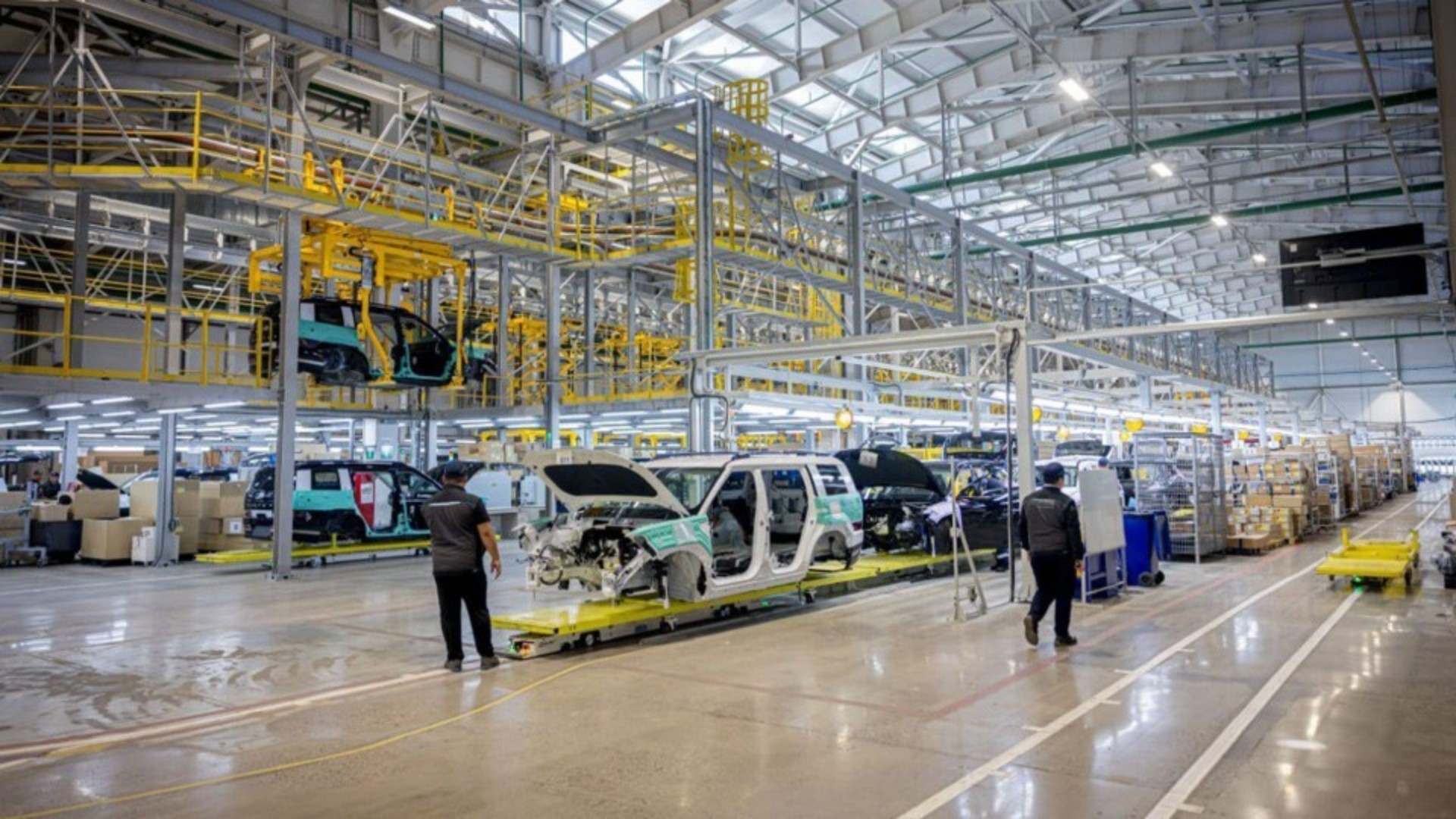
The qualitative shift in the industrial model is reflected in the transition from complete knock-down (CKD) assembly to the manufacturing of high-value-added products. Machinery building serves as a prominent example of this transition to more complex domestic manufacturing: over the course of seven months, the sector grew by 22%, producing output worth 3.2 trillion tenge. Over 96,000 vehicles were produced, with passenger car manufacturing increasing by 37.2%, buses by 27.6%, and specialized equipment by 45.1%. The share of complete knock-down (CKD) assembly reached 28.3%.
The launch of full-cycle plants, including KIA Qazaqstan in Kostanay and the multi-brand Astana Motors Manufacturing plant in Almaty (capable of producing 90,000 vehicles per year), is forming a complete industrial cluster. Local manufacturing of tires, batteries, seats, and multimedia systems has already been established around these facilities. In the agricultural sector, 10 domestic enterprises meet 90% of the country's demand for tractors and combine harvesters.
In railway machinery manufacturing, output reached 345 billion tenge: passenger car production grew by 10.7%, electric locomotives by 23.8%, and the production of tank cars was successfully mastered. The share of local content at the "Locomotive Assembly Plant" in Astana reached 75%.
In metallurgy, total output reached 8.1 trillion tenge. Steel production grew by 4.1%, pig iron by 5.8%, seamless pipes by 30.4%, and rebar by 10.5%. Production capacities are actively expanding: the Qarmet integrated steel plant is implementing a $3.5 billion modernization program, while new copper smelters with a capacity of 300,000 tons of cathode copper each are being built in the Abai region and the city of Balkhash, alongside the Mineral Product International ferroalloy plant.
The chemical industry grew by 26.9%, with total output reaching 1 trillion tenge. This growth was driven by an increase in nitrogen fertilizer production (+5.8%), caustic soda (+5.8%), and a 3.3-fold surge in hypochlorites output.
Measures aimed at protecting the domestic market created additional conditions for growth in the construction and light industry sectors. Following the import ban, domestic cement production increased by 15.6%, stone products by 11%, glass by 10%, and drywall by 6.5%. Light industry experienced an 80.1% growth, reaching 125.5 billion tenge, with textile manufacturing increasing 2.2 times, clothing output by 27.5%, and leather production by 20.3%.
Off-Take Contracts: Guaranteed Demand for Domestic Plants
Providing domestic enterprises with guaranteed demand has become a top priority. In his Address "Economic Course of a Just Kazakhstan," President Kassym-Jomart Tokayev set the task of increasing the presence of domestic products in regulated procurement and elevating the system of off-take contracts with Kazakhstani manufacturers to a new level, aiming to bring the share of such contracts to 10%, or approximately 2 trillion tenge annually.
Following the President's directives, the off-take contract mechanism—which guarantees manufacturers the advance purchase of planned production—has been established as a foundational tool for the country's industrialization. In the first half of 2026, subsoil users and the quasi-public sector concluded long-term agreements and off-take contracts worth 466 billion tenge.
Under the Samruk-Kazyna Fund, procurement from domestic producers doubled, exceeding 2.1 trillion tenge. From January to June 2026, contracts worth 594 billion tenge were signed, marking a 46% increase. Cooperation with subsoil users continues to expand: 177 off-take contracts worth 80.4 billion tenge have been concluded, with a pool of future guaranteed orders valued at an additional 157 billion tenge.
Digital Filter and Access to Raw Materials
Support for manufacturers is becoming increasingly targeted. The Registry of Kazakhstani Manufacturers was launched, verifying through digital audits the operational status of 6,946 active enterprises and removing more than 1,100 fictitious suppliers.
Access to raw materials for domestic processors has been significantly expanded: enterprises now have the right to purchase 25 types of local raw materials, including copper, aluminum, lead, zinc, and rolled steel, at discounts of up to 5% off global exchange prices and up to 50% off export prices. As a result, domestic processing rates have accelerated: consumption of primary aluminum increased by 35% to 77,700 tons, zinc by 45% to 2,600 tons, and cathode copper by 10% to 20,400 tons.
Investment Effect and Capital Returns
In 2026, Kazakhstan plans to launch 200 industrial projects worth 1.7 trillion tenge. Of these, 84 production facilities valued at 337.4 billion tenge have already been commissioned, creating nearly 6,000 jobs. Upon reaching full design capacity, these plants will generate 1.5 trillion tenge worth of goods annually, with roughly a third dedicated to export.
The mechanism of Special Economic Zones (SEZs) is yielding a direct economic impact: 577 projects across 18 zones have attracted 11.1 trillion tenge in investments and created over 39,000 jobs. Furthermore, tax revenues from residents reached 865.4 billion tenge, compared to state infrastructure expenditures of 507.4 billion tenge.
A closed-loop industrial ecosystem is taking shape in the country: affordable raw materials domestically, guaranteed sales through off-take contracts, and strict digital oversight. This strategy ensures that support is effectively directed toward processing development and the production of high-value-added goods.
#Address of the Head of State #Digitalization #Manufacturing industry



Stay updated about the events of the Prime minister and the Government of Kazakhstan - subscribe to the official Telegram channel
Subscribe