06 October 2026, 10:36
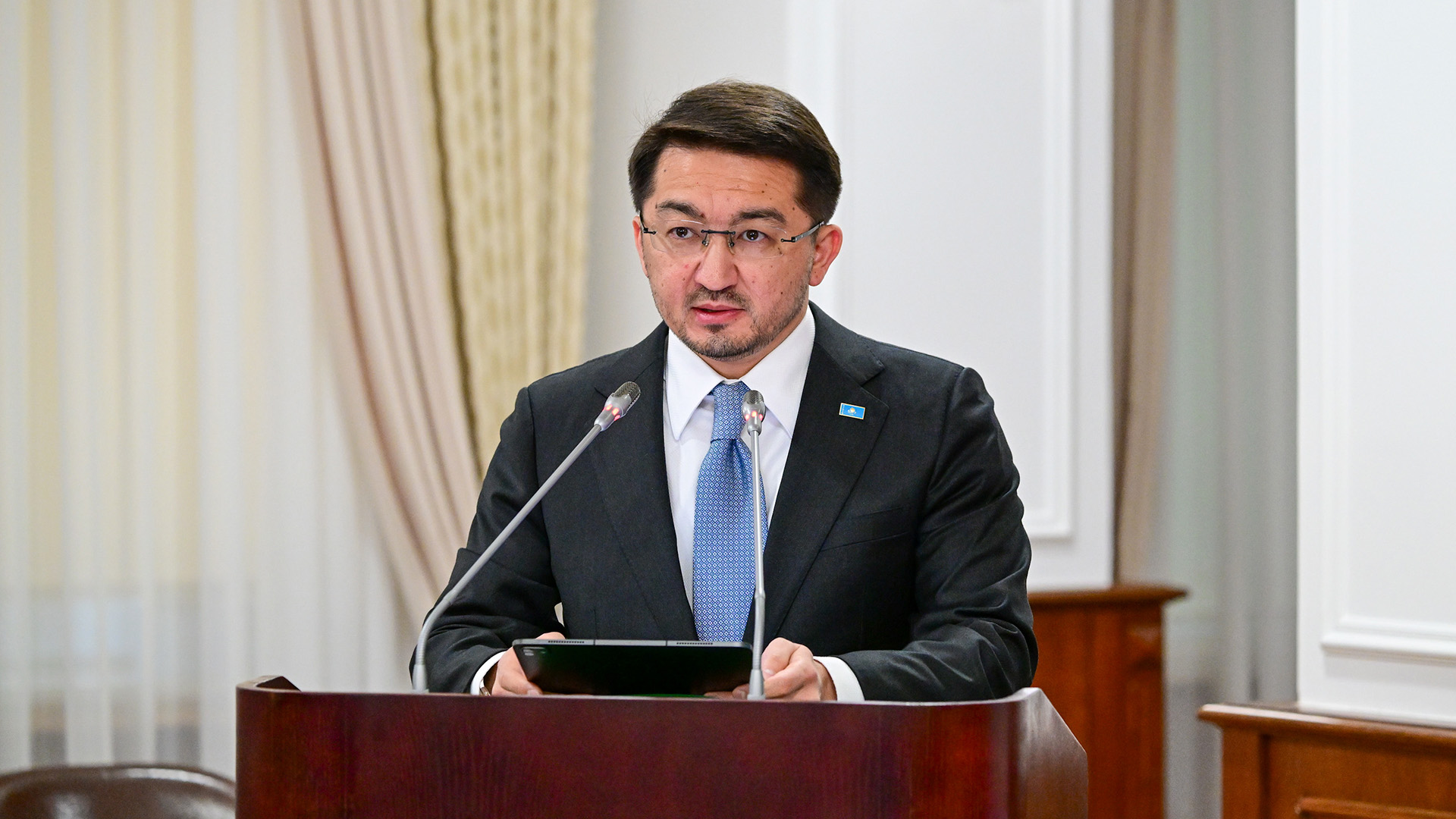 As part of implementing the Digital Qazaqstan Strategy through 2029, a unified end-to-end system for monitoring digital initiatives using artificial intelligence has been built in the country. This was announced at the Government session by Deputy Prime Minister and Minister of Artificial Intelligence and Digital Development Zhaslan Madiyev.
The Deputy Prime Minister noted that the Digital Qazaqstan strategy through 2029 was approved by Decree of the Head of State, and the Action Plan for its implementation was approved by the Government. Specific measures, timelines, and responsible state agencies have been defined. Monitoring of execution is provided with the application of artificial intelligence, including tracking deadlines, financing, and emerging risks. At the same time, personal responsibility of top executives for their timely implementation is fixed.
The QazTech platform has become the foundation of the digital ecosystem for public services and social support. Migration of digital systems planned for the current year is 92% complete. QazTech integrates state services and data on a single digital platform. This serves as the basis for transitioning to the "Life Track" principle, where services are provided proactively based on key life situations of citizens.
"The 'Social Wallet' provides targeted social support and covers 3 million users. Artificial intelligence in e-Otinish has processed over 3.2 million requests. There are 51 services available via eGov GPT. By the end of the year, their number is planned to increase to 150 of the most in-demand services, which generate 80% of traffic. By 2028, the share of AI-powered services is planned to reach 40%, and by 2029—to reduce service delivery time by half," Zhaslan Madiyev reported.
Concurrently, the operational format of Public Service Centers (PSCs / ЦОН) is changing. In new digital population offices, services can be obtained independently via terminals with an embedded digital assistant, eGov GPT, or, if necessary, with the help of a consultant. Five digital offices have already opened across four regions, while funding issues have been resolved in ten additional regions. The ten regions with secured funding must complete premise preparation and open offices by the end of the year. The remaining six regions need to accelerate work, secure funding, and determine specific opening dates. Access to the new format must be provided in all regions.
The next area is the digital transformation of regions. Smart City solutions are being deployed, including drone infrastructure, water management, urban services, and AI diagnostics of diseases. However, according to the Vice Prime Minister, a systematic approach is currently lacking, as solutions develop in fragmentation and are not integrated with one another. The work of the Akimat of Astana was highlighted separately.
"The capital is actively implementing AI-Native City solutions and has entered the top 15 cities globally under the WIPO City of Innovation initiative. Almaty is also transitioning to this model. Our task is to combine solutions based on shared data, computing capacity, and situational centers. Successful practices must be introduced systematically across the whole country. This will enable comprehensive management of transport, utility infrastructure, and security. Today, Smart City solutions cover 25% of the urban population. In 2027, we plan to increase coverage to 50%, and in 2028—to 70%," the Deputy Prime Minister noted.
In the area of modern telecom infrastructure development, work is actively underway on key projects. Along the Trans-Caspian Fiber Optic Communication Line (FOCL), 390 kilometers of cable have been laid from the shore of Sumgait (Azerbaijan) to the shore of Aktau, with launch scheduled for this month. Over 4,000 5G base stations have been installed in more than 20 cities. Together with Beeline and Starlink Mobile, Direct-to-Cell technology was launched, providing text messaging and a basic level of internet anywhere in the country via direct satellite-to-smartphone connectivity. Android support is already provided, while iOS support is currently in progress.
Internet access has been provided to 1,500 carriages across 124 trains on 50 railway routes, and work continues to connect seven aircraft and 50 tourist locations. Half of the total 4,511 km length of the "West – East" hyper-highway cable has been laid, with commissioning targeted before the end of the year. In rural areas, 370 villages have been connected and 11,819 km of communication lines laid against the current year's plan of 1,600 villages. In 2027, it is planned to provide coverage along 40,000 km of regional and national highways with the installation of over 500 antenna-mast structures.
For the application of artificial intelligence, a unified data management system is being formed. Based on Smart Data Ukimet, sectoral data lakes are being developed in finance, healthcare, and transport, with their launch planned next year in energy, industry, and agriculture (a total of at least ten sectoral data lakes are planned). The necessary regulatory framework has been established. By 2029, at least 80% of state agencies must achieve the target data management maturity, and at least 90% of datasets must meet quality requirements.
In cybersecurity, which provides for the protection of personal data and critical digital assets, 481 digital systems have been connected to the personal data access control service. All state systems are covered, and the 100% target has already been achieved (from January to August, over 370 million requests were processed in eGov, and 719 thousand consent revocations were recorded). Meanwhile, only 130 out of 432 critical digital assets are connected to the operational information security center. By the end of the year, another 86 assets need to be connected to reach 50% coverage, rising to 70% in 2027 and 90% in 2028. In parallel, cyber literacy is being raised (September was declared Cyber Month with educational events, industry meetings, and regional forums). Training of cybersecurity specialists is provided through grants at 12 universities, with plans to increase the number of grants to approximately 16.5 thousand by 2030.
To develop a competitive national IT ecosystem, Astana Hub unites over 2.5 thousand residents. By the end of 2025, Kazakhstan's IT service exports exceeded $1.1 billion. A $115 million venture fund of funds was formed through Alem Ventures. Strong technology companies and competitive IT products have taken shape. To train engineers and researchers, Qazaq AI Research University and Network School were launched, preparing domestic and foreign IT engineers to export services to global markets. Talent and investors are attracted through Trusted Kazakhstan (the Digital Nomad Visa / Residency program received over 1.9 thousand applications from 80 countries, while the Altyn Visa is being launched for strategic investors). IT hub infrastructure is expanding in Astana and the regions, with the international network of hubs covering the US, China, Malaysia, and the UAE, while work is underway to open Eurasian Hub in the UK. By 2029, IT exports are planned to reach at least $2 billion, cultivating at least three unicorn companies.
Under the "State as a Platform" model, artificial intelligence is already used for processing requests, preparing meeting minutes, and translation, while civil servants are trained to build their own AI tools. Supercomputer capacities are accessible to startups, universities, state agencies, and companies. The National AI Platform provides a single framework for developing AI solutions, offering access to training modules, datasets, and large language models for self-learning and product development across various industries. By 2029, interagency interaction timelines should be halved, and the operational workload on civil servants reduced by up to 30%.
One of the flagship projects of the new economy is the "Data Center Valley" with a capacity of at least 1 GW. Land has been allocated in Ekibastuz, an operator identified, engineering infrastructure and power supply from GRES-1 secured, and construction of the first facilities initiated. In 2027, data centers with a total capacity of 186 MW are planned for commissioning, followed by another 109 MW in Q2 2028. A $10 billion package of agreements was signed with Firebird AI, and interest has been shown by over 20 international technology companies and investors to build the region's largest computing power hub.
In space communication systems, two KazSat satellites generated 72 billion tenge in revenue (the creation of KazSat-3R is planned by 2029 to replace current spacecraft). In the Earth remote sensing system, 3 satellites are operational, with the economic impact from space monitoring totaling 977 billion tenge over five years. Plans include creating 6 new satellites (3 high-resolution and 3 medium-resolution spacecraft) to enhance imaging accuracy and coverage, as well as forming an international constellation of 14 satellites by 2030. Three export projects worth $70 million are being implemented with Mongolia, Congo, and Nigeria.
In the new robotics and Physical AI industry, engineer training is linked to developing local production. Projects with international partners are underway in Astana and Almaty, involving technology localization, R&D, and competency transfer (construction of both plants is scheduled for completion next year), while educators are being trained and school laboratories developed.
In the development of unmanned systems and the low-altitude economy, autonomous taxi pilots are ongoing in Astana, Almaty, and Kosshy, and drone delivery pilots have launched in Almaty (Reference: regulations defining testing conditions, operational access, and safety enforcement were approved by joint order of the MAIDC, Ministry of Transport, and Ministry of Internal Affairs; the pilot is designed for three years). Demonstration flights of air taxis took place in Astana and Alatau, accompanied by legislative changes for operating such aircraft and developing landing infrastructure (Reference: AutoFlight conducted a test flight in Alatau on May 19; AutoFlight Prosperity flew over the "Qazanat" hippodrome without passengers on July 24 with a 6-person capacity; EH216-S completed a passenger demonstration flight with 2 people, speeds up to 130 km/h, and a range up to 35 km). Concurrently, domestic drone production is being developed: commercial rides and expanded drone delivery are planned for 2027, followed by commercial air taxi flights in 2028, prioritizing safety and infrastructure readiness.
In the crypto industry, the legal framework was created by the Law "On Digital Assets" and the Presidential Decree "On Measures to Stimulate and Develop the Digital Asset Industry," which provides for transferring cryptocurrency turnover into a regulated contour, tax incentives, and using associated petroleum gas for digital mining. On September 12, strategic digital mining with a capacity of 90 MW was launched; a "70/30" mechanism was introduced to attract investment into new generation capacity, and the CryptoPay system is available at over 5,000 retail locations.
In conclusion, it was emphasized that the presented projects cover all five levels of the "Digital Qazaqstan" strategy, and their execution within set deadlines should ensure productivity growth, the development of new industries, and an improved quality of life for citizens.
#Digitalization #Government session #Investments #Transport



Stay updated about the events of the Prime minister and the Government of Kazakhstan - subscribe to the official Telegram channel
Subscribe